The Country That Invented More Western Culture Than Any Other
Italy produced the Roman Empire, the Catholic Church, the Renaissance, the modern banking system, opera, pasta in its globally dominant form, pizza as an exportable concept, and the visual language through which most of the Western world still thinks about beauty. This is not a claim made by Italians; it is a straightforward accounting of where ideas, institutions, and aesthetic vocabularies originated. The country was the first to figure out that cities could be organised around public squares rather than citadels, that banks could issue paper credit in place of gold, and that church domes could span 40 metres without external buttressing. These were not small discoveries.
And yet, by most modern political measures, Italy is a relatively recent country. Unification under the Kingdom of Italy was completed only in 1871, after a series of wars of independence against Austria and the Papal States that British and French readers once followed with the attention now given to Middle Eastern conflicts. Before 1861, “Italy” was a geographical expression, a peninsula of rival city-states and foreign dominions speaking mutually difficult dialects. Today’s Italy — a G7 economy, a founding member of the European Union, home to 58 million people and 59 UNESCO World Heritage Sites (the most of any country in the world) — is still navigating the relationship between its overwhelming cultural inheritance and its much younger national self.
A Brief History
The Italian peninsula has been continuously inhabited by complex societies for roughly 3,000 years. The pre-Roman landscape included Etruscan city-states in Tuscany (peak 8th-5th century BC), Greek colonies across the south and Sicily (Syracuse, Naples — originally Neápolis), and smaller Italic peoples from whom the Latin-speaking Romans emerged.
Rome
The Roman foundation is traditionally dated to 753 BC. By the 1st century BC the Roman Republic controlled the Mediterranean; by 117 AD, under the emperor Trajan, the Empire reached its maximum extent from Scotland to Mesopotamia. The Western Roman Empire fell in 476 AD, fragmenting the peninsula into Ostrogothic, Byzantine, Lombard, and papal territories that would take a thousand years to reconsolidate.
The Medieval Maritime Republics
From the 10th century, the coastal city-states of Venice, Genoa, Pisa, and Amalfi built commercial empires that dominated Mediterranean trade. Venice in particular — politically independent, wealthy beyond any other European city, with an elected doge and a mercantile constitution that lasted from 697 to 1797 — was the prototype of the modern commercial republic.
The Renaissance
From the 14th to 16th centuries, the Italian city-states (Florence, Rome, Venice, Milan) produced a cultural flowering that altered European thought permanently. Leonardo da Vinci, Michelangelo, Raphael, Botticelli, Titian, Galileo all worked within a roughly two-century window in a territory smaller than modern Pennsylvania. The Medici banking family of Florence funded much of it. The invention of perspective (Brunelleschi, c. 1415), humanist philology, double-entry bookkeeping, and the modern diplomatic embassy all happened here.
Unification and the Twentieth Century
The Risorgimento — the 19th-century unification movement — took its definitive form under the leadership of Count Cavour (political strategy), Giuseppe Garibaldi (military campaigns including the 1860 conquest of Sicily and Naples with only 1,000 men), and King Victor Emmanuel II. The Kingdom of Italy was proclaimed in 1861, with Rome added in 1870 after the withdrawal of French troops who had been protecting the Papal State.
The 20th century brought Mussolini’s Fascist regime (1922-1943), catastrophic involvement in World War II, the establishment of the Italian Republic in 1946 (following a popular referendum that narrowly abolished the monarchy), and one of post-war Europe’s fastest economic recoveries — the “Italian economic miracle” of 1958-1963, which transformed a mostly agrarian country into a G7 industrial economy within a generation.
Geography and Climate
Italy covers 301,340 km² — about the size of Arizona — and stretches 1,200 km from the Alpine north to the southern tip of Sicily. The country’s geography is defined by two mountain ranges (Alps and Apennines), a long coastline, two major islands, and a series of volcanic features that include the only active volcanoes in continental Europe.
The Three Macro-Regions
- Northern Italy — the Po Valley plain, Italy’s industrial heartland, bordered by the Alps to the north and the Apennines to the south. Milan, Turin, Bologna, and Venice are here. The region generates roughly 55% of Italian GDP.
- Central Italy — Tuscany, Umbria, Lazio, the Marches. Olive groves, hilltop towns, vineyards, and the overwhelming concentration of medieval-Renaissance art that anchors global tourism. Rome is the administrative and cultural centre.
- Southern Italy and the islands — the Mezzogiorno. Naples, Sicily, Calabria, Puglia. Warmer climate, stronger Greek and Arab cultural layers, and economic development that has historically lagged the north.
Volcanoes
Italy is Europe’s most volcanically active country. Mount Etna on Sicily (3,357 m) is Europe’s highest active volcano and one of the world’s most continuously active, with eruptions recorded since before 1500 BC. Mount Vesuvius near Naples famously destroyed Pompeii and Herculaneum in 79 AD and remains one of the most dangerous volcanoes in the world due to the 3 million people living in its red zone. Stromboli in the Aeolian Islands has been in near-constant mild eruption for at least 2,000 years.
Climate
Italy spans four climate zones from north to south: Alpine in the mountains, continental-temperate in the Po Valley, Mediterranean along most of the coast, and arid-Mediterranean in Sicily and Puglia. Summers are hot and largely dry; winters are cold and humid in the north, mild in the south.
Culture, Language and Religion
The Language
Italian is the official language, derived from the Tuscan dialect standardised through Dante Alighieri’s Divine Comedy (completed 1321) and Petrarch’s poetry. Standard Italian is a remarkably recent achievement — at unification in 1861, only about 2.5% of the population could speak it fluently. The rest spoke regional languages: Sicilian, Neapolitan, Venetian, Lombard, Piedmontese, Friulian, Sardinian, and dozens of local varieties.
Regional languages remain strong in daily life — Neapolitan and Sicilian are spoken by millions, and several (Sardinian, Friulian, Ladin) have formal legal recognition as minority languages. Italian television and schooling diffused Standard Italian across the 20th century, but a visit to rural Sicily or Friuli still rewards listening for the older linguistic layers.
Regional Identity
Campanilismo — literally loyalty to one’s own church bell tower — remains one of the organising principles of Italian social identity. A Neapolitan is a Neapolitan first, an Italian second; a Florentine and a Sienese have teased each other for 900 years. This is not just sentimental — regional cuisines, dialects, political habits, and even architectural preferences differ more sharply in Italy than in comparably sized European countries.
Religion
Italy is constitutionally secular since 1985, but remains overwhelmingly Catholic in cultural identity — roughly 70% of the population self-identify as Catholic, though regular church attendance is much lower (around 18%). The presence of Vatican City inside Rome, and the exceptional density of churches across the country (over 65,000 parish churches and an estimated 100,000+ total chapels and oratories), gives religious architecture an unavoidable role in the landscape.
The Economy
Italy is the world’s eighth-largest economy by nominal GDP (~$2.4 trillion in 2024) and the third-largest in the euro area after Germany and France. The economy is export-oriented, specialised in mid-sized family-owned manufacturing, and famously concentrated in industrial districts — geographically clustered networks of firms producing within narrow specialities (furniture in Brianza, eyewear in Belluno, knitwear in Carpi, tiles in Sassuolo, yachts in Liguria).
Strengths
- Manufacturing — Italy is the second-largest manufacturing economy in the EU after Germany, with global leadership in textiles and apparel, leather goods, food processing, precision machinery, and yachts.
- Luxury — Ferrari, Lamborghini, Gucci, Prada, Valentino, Armani, Versace, Bulgari. The “Made in Italy” label carries a price premium comparable to “Swiss-made” or “German-engineered”.
- Tourism — Italy consistently ranks in the global top 5 for international arrivals. Tourism represents roughly 13% of GDP when multiplier effects are included.
- Food and wine — Italy is the world’s largest wine producer (roughly 4.9 billion bottles in 2023), ahead of France, and the EU’s second-largest agricultural producer.
- Fashion — Milan Fashion Week is one of the Big Four globally.
Challenges
Italy’s economy has grown more slowly than its EU peers since the 2008 crisis, with public debt around 135% of GDP (second-highest in the euro area after Greece) and a youth unemployment rate that remains stubbornly high. The country has one of the world’s oldest populations — more than 24% of Italians are over 65 — and birth rates among the lowest in Europe. Southern Italy’s economic gap with the north remains persistent despite decades of policy attempts to close it.
Cuisine
Italian cuisine is among the most globally dominant food cultures in history — pasta, pizza, espresso, risotto, gelato, tiramisu, parmesan, and prosciutto have become international staples. But what most of the world eats as “Italian food” is a simplified, often northern-Italian-American version of a much more varied regional tradition.
Regional Signatures
- Emilia-Romagna (Bologna, Parma, Modena) — the heartland of Italian cuisine. Tortellini, lasagne alla bolognese, Parmigiano Reggiano, prosciutto di Parma, balsamic vinegar of Modena, mortadella. Bologna is nicknamed la grassa (the fat one).
- Tuscany — bistecca alla fiorentina, ribollita, pici pasta, wild boar ragù, Chianti, Brunello di Montalcino, Vernaccia. Cuisine built on the cucina povera tradition of peasant resourcefulness.
- Rome and Lazio — carbonara, cacio e pepe, amatriciana, gricia (the four Roman pasta dishes), saltimbocca, artichokes cooked alla giudia.
- Naples and Campania — pizza (invented in Naples; Neapolitan pizza was added to UNESCO’s Intangible Cultural Heritage list in 2017), mozzarella di bufala, limoncello, sfogliatella, pastiera.
- Sicily — arancini, pasta alla Norma, cannoli, granita, swordfish, couscous (in the Trapani region, reflecting Arab-Norman heritage).
- Piedmont — truffles of Alba, risotto, agnolotti, Barolo and Barbaresco wines, bagna cauda, bicerin (espresso + chocolate + cream).
The Coffee Ritual
Italian coffee culture is one of the country’s quieter cultural exports. An espresso at a bar is a 30-second transaction, ordered at the cash register, drunk standing up, and rarely costs more than €1.20 anywhere outside major tourist sites. Cappuccino is a breakfast drink — ordering one after 11 AM marks you as a foreigner, and ordering one after dinner is considered a minor cultural transgression.
Nature and UNESCO Sites
Italy has 59 UNESCO World Heritage Sites (as of 2024), the highest count in the world. Standouts include:
- Historic Centre of Rome, the Holy See, and San Paolo Fuori le Mura — one combined site covering most of the ancient and papal cities
- Historic Centre of Florence — the city as a single continuous museum
- Venice and its Lagoon — added 1987, the city that is itself both heritage site and ongoing preservation problem
- Archaeological Areas of Pompeii, Herculaneum, and Torre Annunziata — the 79 AD Vesuvius eruption’s urban time capsules
- Pisa’s Piazza del Duomo — the Leaning Tower, baptistery, and cathedral
- Cinque Terre — five cliff-clinging villages on the Ligurian coast
- Dolomites — alpine limestone peaks in northern Italy, a natural site
- Amalfi Coast — 50 km of coastline south of Naples
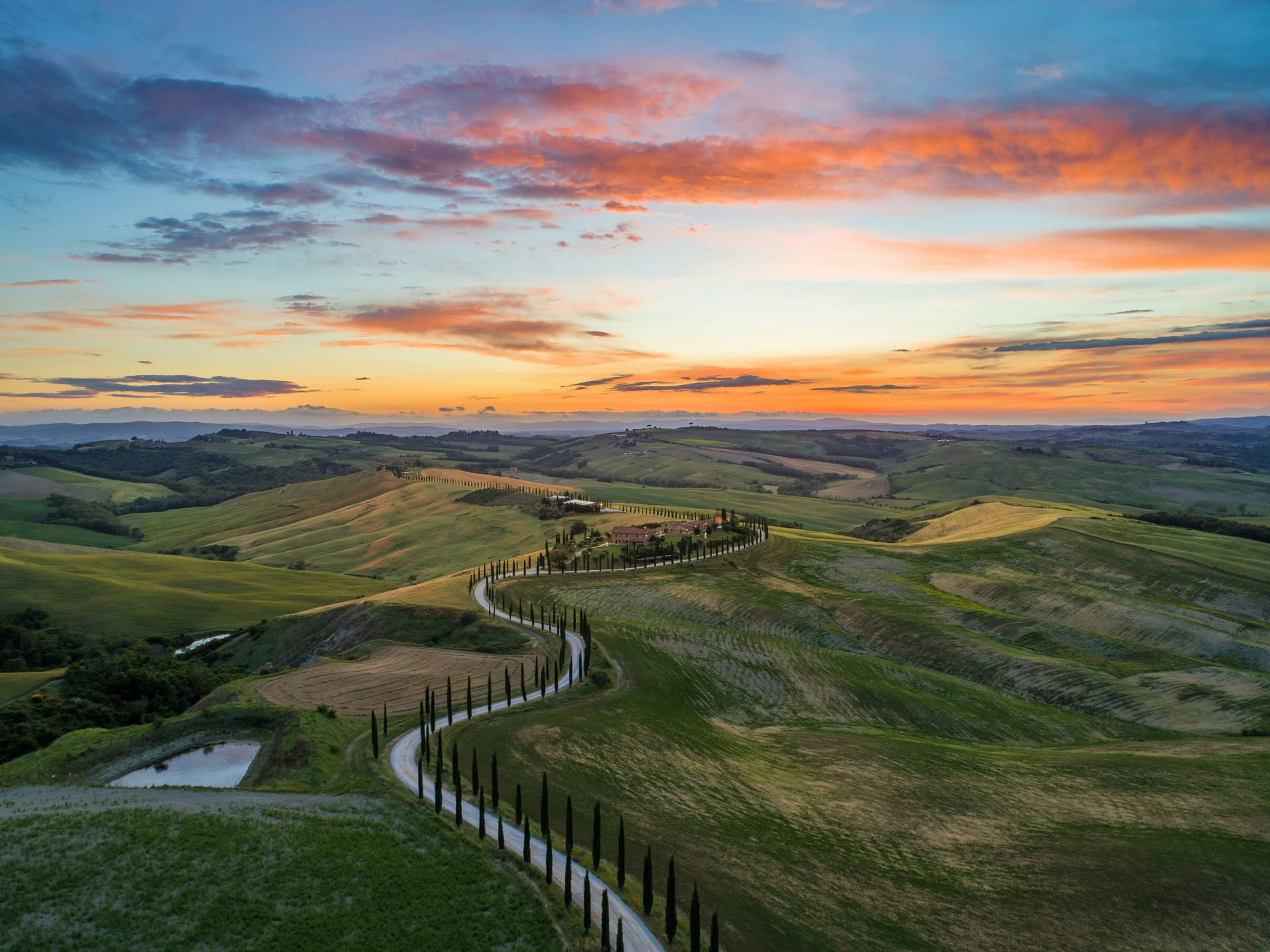
- Val d’Orcia — the southern Tuscan landscape that shaped Renaissance ideals of rural beauty
National Parks
Italy has 25 national parks covering roughly 5% of the country. The Gran Paradiso (founded 1922) was the country’s first; the Dolomiti Bellunesi protects the UNESCO-listed mountains; Stelvio in the central Alps covers 1,307 km² and is one of Europe’s largest protected areas.
Travel Guide: Practical Information
Entry
Italy is a Schengen Area member — visa-free for up to 90 days in any 180-day period for citizens of the US, UK, Canada, Australia, Japan, and most of Latin America. ETIAS authorisation is expected to apply from mid-2026 for visa-exempt travellers.
Best Seasons
- April-early June — the ideal window. Warm but not hot, Tuscany is bright green, the classical cities are not yet at peak crowds.
- September-October — second-ideal. Vineyards in Tuscany and Piedmont are at harvest; Sicily and Puglia still have beach weather into early October.
- July-August — peak season. Rome empties out in mid-August (many Italians leave for their own ferragosto holidays); the coastal resorts are extremely crowded.
- Late November-February — low season for most regions except the Alps, where ski season runs December-April in Courmayeur, Cortina, and the Dolomites.
Transport
- Trenitalia and Italo run competing high-speed rail on the same tracks — Rome-Florence in 90 minutes, Rome-Milan in 3 hours, Rome-Naples in 70 minutes. Book in advance; walk-up fares are steep.
- Rental cars are essential for Tuscany, Umbria, Puglia, and Sicily beyond the main cities. Avoid driving in Rome, Florence, Naples, or Venice — the historic centres have ZTL (limited traffic zone) cameras that issue heavy fines to unregistered cars.
- Ferries connect the mainland to Sicily (from Villa San Giovanni), Sardinia (from Civitavecchia, Genoa, Livorno), and the Aeolian Islands.
Budget
Italy is less expensive than France or Scandinavia, but prices in Rome, Milan, and Venice approach Paris levels in peak season. A reasonable daily budget is €120-€180 for mid-range travel, with considerable savings possible in Puglia, Sicily, and smaller Umbrian and Abruzzese towns.
Restaurant Etiquette
- Coperto — a small per-head cover charge (€1.50-€4) is standard at most restaurants. It is not a tip; tipping is modest (a few euros for exceptional service) or unnecessary.
- Service times are fixed — most kitchens close between 2:30 PM and 7:30 PM, and some stop serving lunch by 2 PM.
- Never order a cappuccino with pasta. Not a rule, but a cultural tic that will cause the server to pause.
Surprising Facts
- The Italian language technically did not exist as a majority spoken language at unification; it was a literary standard that most Italians had to learn as a second language through schooling in the late 19th and early 20th centuries.6
- Rome has a law against eating or drinking on or near historic monuments — enforced sporadically, but fines can reach €450 for picnicking on the Spanish Steps.3
- San Marino, entirely surrounded by Italy, is the world’s oldest continuous republic (founded 301 AD according to tradition, constitutionally continuous since 1600).6
- Italy’s Carabinieri are a military police force that is legally part of the armed forces and reports to two ministries simultaneously (Interior for policing, Defence for military role) — a structure unique in Europe.6
- Pasta al dente as a universal Italian convention emerged only in the 20th century; 19th-century Neapolitan pasta was cooked for much longer by modern standards.6
- Italy did not officially exist as a unified country from the fall of the Western Roman Empire in 476 AD to unification in 1861 — a gap of 1,385 years, the longest of any major European nation.6
Sources and References
See the list of cited sources in the page frontmatter — UNESCO, World Bank, ENIT (Italian National Tourist Board), Istat, Italian Ministry of Culture, Encyclopaedia Britannica, and Banca d’Italia.