The World’s Most Visited Country, and the Arguments That Explain Why
France has topped the global ranking of international tourist arrivals nearly every year for four decades — a streak so uninterrupted that the UN World Tourism Organization simply assumes France will win again before publishing the official totals. In 2023, around 100 million visitors crossed the French border for tourism, more than the country’s own population of 68 million. They came for reasons that French society has been assembling, often contentiously, for roughly fifteen centuries: cuisine, cathedrals, beaches, wine country, Alpine skiing, the accumulated weight of a hundred rival courts and republics, and the single most visited museum on earth.
But France is not only a tourist hypothesis. It remains Western Europe’s most populous country after Germany, its largest by land area, a nuclear-armed permanent member of the UN Security Council, a founder of the European Union, and the world’s seventh-largest economy. What makes it unusual — and makes writing about it difficult — is that this political and economic weight coexists with a cultural idea of France that its own citizens actively dispute, revise, and protect with a passion that occasionally baffles outsiders. “La France” is a country, a cuisine, a style, a political-philosophical tradition, and an argument that has been going on since 1789 without resolution.
A Brief History
French history is usually told in layers. The land was inhabited by Celtic Gauls from roughly 500 BC; Julius Caesar’s conquest in 58-50 BC absorbed Gaul into the Roman Empire and left behind a Latin-derived language and an infrastructure of roads, aqueducts, and cities that the French administrative map still faintly echoes. The collapse of the Roman West brought the Franks — a Germanic confederation whose king Clovis converted to Catholicism around 496 AD and gave his name to the country, though the Franks themselves spoke a Germanic language that contributed almost nothing to modern French vocabulary.
The French monarchy took its durable form under the Capetian dynasty (987-1328) and its successors the Valois and Bourbons, who expanded royal authority over the feudal patchwork across seven centuries. The high-water mark was the reign of Louis XIV (1643-1715), whose 72-year rule, centralised administration, and architectural self-display at Versailles became the model that every other European absolutist court tried and failed to imitate.
The Revolution and Its Consequences
The French Revolution of 1789 ended the monarchy within four years and began the argument about French political identity that has not yet concluded. Between 1789 and 1870, France ran through two republics, two monarchies, two empires, and a commune, a pace of regime change without parallel in a major European state. The Declaration of the Rights of Man and of the Citizen (1789) remains part of the current French constitutional framework; the Napoleonic Code (1804) influenced legal systems across Europe and the Americas.
The Twentieth Century
France entered the 20th century with its largest colonial empire after Britain’s, and exited it having dismantled that empire under varying degrees of violence — the Algerian War of Independence (1954-1962) in particular left wounds that French politics has never fully processed. Two world wars were fought substantially on French soil; the German occupation of 1940-1944, the Resistance, and the collaborationist Vichy regime are the defining modern reference points, more immediate for most French people than anything from the Napoleonic era.
The Fifth Republic, established by Charles de Gaulle in 1958, remains the current constitutional framework. It gives France a semi-presidential system that has, despite occasional crises, been remarkably stable compared to the republics that preceded it.
Geography and Climate
France covers 643,801 km² including overseas territories, and 551,695 km² in metropolitan (European) France alone — still the largest territory in Western Europe. The country is famously shaped like a hexagon and called exactly that by the French themselves (l’Hexagone). It has the widest range of landscapes of any Western European country, a geographical variety that directly underpins its tourism economy.
Five Major Regions
- The northern plains — Paris basin, Picardy, Normandy. Low-lying, intensively agricultural, punctuated by the great Gothic cathedrals (Amiens, Beauvais, Reims, Rouen).
- The Atlantic west — Brittany, Pays de la Loire, Aquitaine. Granite coasts in the north, Atlantic surf beaches in the south, and the Loire Valley châteaux between them.
- The Mediterranean south — Provence, Côte d’Azur, Languedoc. Olive groves, lavender, Roman ruins (the Pont du Gard, the Arles arena), and the beaches that launched 20th-century mass tourism.
- The Alps and Pyrenees — mountain ranges on the Italian, Swiss, and Spanish borders. Mont Blanc, at 4,808 metres, is Western Europe’s highest peak.
- The central highlands — Massif Central, a volcanic plateau in central France that contains the Puy volcanic range, the Millau Viaduct (at 343 metres, the tallest bridge in the world), and some of the country’s most-preserved rural traditions.
Overseas France
France is unusually extended for a European state — it has 13 overseas territories covering 120,369 km², spread across the Caribbean (Guadeloupe, Martinique), South America (French Guiana), the Indian Ocean (Réunion, Mayotte), the Pacific (New Caledonia, French Polynesia), and sub-Antarctic islands. These territories make France the only European country with actual national territory on five continents, and give it the second-largest exclusive economic zone in the world after the United States.
Climate
Metropolitan France divides into four broad climate zones: Oceanic in the west (Brittany, Normandy, the Atlantic coast), continental in the east and interior (Burgundy, Lorraine), Mediterranean in the south, and Alpine/mountain in the ranges. Summers are reliably warm except in the northwest; winters are mild in the south and snowy in the mountains.
Culture, Language and Religion
French culture has had the unusual historical privilege of existing in a country large enough to be a great power and small enough to retain strong regional identities. The result is a national culture that is simultaneously a single coherent tradition (think of the bistro, the pharmacie, the postman’s blouse bleue) and a patchwork of 20+ regional traditions (Breton Celtic music, Provençal cuisine, Alsatian German-French hybrid architecture, Basque pelota).
The Language
French is the only official language. Its status is legally protected — the Académie française, founded by Cardinal Richelieu in 1635, publishes the official dictionary and passes judgement on neologisms, a role no English-speaking country has a direct equivalent for. French is also one of the six official UN languages, the working language of the European Court of Justice, and — because of the continuing imprint of French decolonisation — one of the most widely spoken second languages in Africa, where the Francophonie has more actual speakers today than in Europe.
Regional languages (Breton, Occitan, Alsatian, Corsican, Basque, Catalan) were severely suppressed in the 19th and early 20th centuries by the Jules Ferry school reforms; they are now being cautiously revived, with bilingual schools and regional media.
Religion
France is a laïque (secular) republic — a constitutional principle dating from the 1905 law separating Church and State. Roughly 40-50% of the population identify as Catholic, though regular church attendance is far lower (around 5%). Islam is the second-largest religion (roughly 8-10% of the population), followed by Protestantism, Judaism, and growing secular/atheist self-identification.
The politics of laïcité are a continuing source of debate — whether and how state secularism should accommodate visible religious practice, especially Muslim practice, has been the subject of successive laws on headscarves in schools (2004), the burqa in public spaces (2010), and more recent bans on the abaya (2023).
The Economy
France has the seventh-largest economy in the world by nominal GDP (roughly $3.1 trillion in 2024) and the third-largest in Europe after Germany and the United Kingdom. Its economic profile is unusually diversified for a G7 country — rather than concentrating in a single sector, France is in the global top ten in agriculture, pharmaceuticals, aerospace, energy, tourism, automotive, luxury, cosmetics, and defence simultaneously.
Key Sectors
- Aerospace — Toulouse hosts the main Airbus assembly lines and is the nucleus of European aerospace. France is also the leading country in satellite launch services (Arianespace operates from Kourou in French Guiana).
- Luxury goods — LVMH, Kering, Hermès, L’Oréal, and Chanel are all French. Luxury represents a larger share of French exports than wine or cheese.
- Aviation and tourism — Paris Charles de Gaulle is Europe’s second-busiest airport; the country’s hôtellerie sector employs around 800,000 people.
- Agriculture and food — France is Europe’s largest agricultural producer, first in wine (roughly 4.7 billion bottles per year), first in cheese (~1,200 varieties, with 46 holding AOC/AOP protected designations), and first in beef in the EU.
- Nuclear power — France generates around 65% of its electricity from nuclear (the world’s highest share), a legacy of the 1970s oil crisis response that has become unexpectedly relevant as European climate policy turns toward decarbonisation.
The Social Model
France’s economic distinctiveness is also political — a strong social safety net, 35-hour working week (2000, though widely negotiated around), 5 weeks of statutory paid holiday, and public healthcare that consistently ranks in the world’s top 10. The flip side is a higher tax burden than most OECD peers and recurring political friction over reform: the 2023 retirement age changes, which raised the pension age from 62 to 64, triggered months of mass protests.
Cuisine
French cuisine was registered on UNESCO’s Intangible Cultural Heritage list in 2010 — specifically the “gastronomic meal of the French”, the ritual of multi-course meals with aperitif, starter, main, cheese, dessert, and wine pairing. The inscription recognised something most French people consider self-evident: that food preparation and shared meals are a structural element of French identity rather than a lifestyle accessory.
Regional Traditions
- Lyon is widely considered the country’s gastronomic capital, with the bouchon lyonnais tradition (convivial bistros serving regional charcuterie, quenelles, and offal dishes). Paul Bocuse’s three-Michelin-star restaurant outside Lyon held its stars from 1965 to 2020.
- Burgundy — beef bourguignon, coq au vin, escargots de Bourgogne, and the world’s most valuable wine appellations (Romanée-Conti, Montrachet).
- Provence — bouillabaisse (marseillaise fish stew), ratatouille, pissaladière, pastis. Olive oil replaces butter in most dishes.
- Alsace — choucroute garnie, flammekueche, riesling. The cuisine is visibly German-influenced, a reminder that the region changed hands between France and Germany four times between 1871 and 1945.
- Normandy and Brittany — oysters, scallops, Camembert, Calvados (apple brandy), crêpes, and the unique Breton butter with large salt crystals.
Bread and Pastry
The baguette was added to UNESCO’s Intangible Cultural Heritage list in 2022. France has roughly 33,000 bakeries, down from 55,000 in 1970 but still the world’s highest density. French patisserie — croissant, pain au chocolat, mille-feuille, éclair, tarte Tatin, macaron, Opéra — is a foundation of global pastry technique, and the word “patissier” has no direct English equivalent for a reason.
Nature and UNESCO Sites
France has 53 UNESCO World Heritage Sites, the fourth-highest count in the world after Italy, China, and Germany. Standouts include:
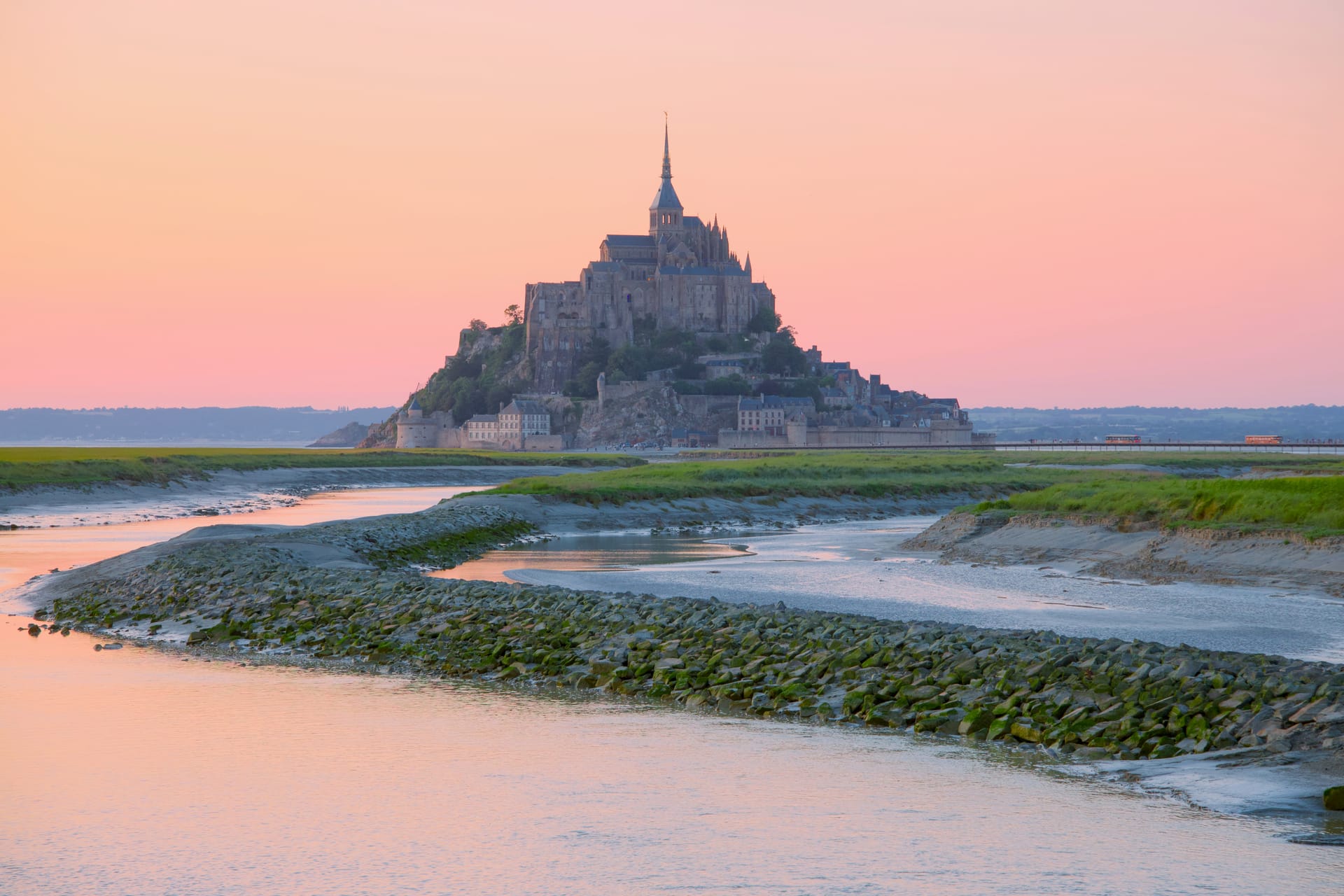
- Mont-Saint-Michel and its Bay — the tidal abbey off the Normandy coast
- Palace of Versailles — Louis XIV’s court complex, built between 1661 and 1710
- Chartres Cathedral — the best-preserved of the great 13th-century Gothic cathedrals
- Banks of the Seine in Paris — the stretch from Pont de Sully to Pont d’Iéna
- Strasbourg Grande-Île — the medieval heart of the Alsatian capital
- Pyrénées — Mont Perdu (shared with Spain) — a cross-border mountain cultural landscape
- Prehistoric Sites and Decorated Caves of the Vézère Valley — Lascaux and 147 other prehistoric sites in the Dordogne
- Routes of Santiago de Compostela in France — the pilgrimage route network
- Volcanoes and Forests of Mount Pelée and the Pitons of Northern Martinique — added 2023, an overseas natural site
National Parks
France has 11 national parks, three of them in overseas territories. The Vanoise (1963) was the country’s first; the Calanques near Marseille protects one of the Mediterranean’s most dramatic coastlines; La Réunion’s cirques, pitons and remparts protect an active volcanic landscape inscribed on the UNESCO list in 2010.
Travel Guide: Practical Information
Entry
France is a Schengen Area member — citizens of the US, UK (post-Brexit), Canada, Australia, Japan, and many others can enter visa-free for up to 90 days in any 180-day period. An ETIAS travel authorisation (similar to the US ESTA) is expected to apply to visa-exempt non-EU travellers from mid-2026. Check current status before travel.
Best Seasons
- April-June — the classic window. Paris in May is reliably pleasant; the Loire châteaux open all their gardens.
- September-October — second-best window. Fewer crowds, harvest season in Burgundy and Bordeaux, still-warm Mediterranean water until mid-October.
- July-August — peak season. Paris can empty out (many Parisians leave for their own holidays in August); the Côte d’Azur, Dordogne, and Provence are extremely crowded and expensive.
- December — Christmas markets in Alsace (Strasbourg, Colmar) are among Europe’s best; ski season opens in late December in the Alps.
Transport
- TGV high-speed rail — the backbone of domestic long-distance travel. Paris-Lyon in 2 hours, Paris-Marseille in 3 hours 5 minutes, Paris-Bordeaux in 2 hours 4 minutes. Book in advance on SNCF Connect for best prices.
- Paris Métro — 16 lines, one of the world’s oldest metro systems (opened 1900). A carnet of 10 tickets or a Navigo weekly pass is the most efficient option.
- Rental cars are essential for the Loire, Dordogne, and Provence regions. French autoroutes are toll roads; budget around €70-€100 for the full Paris-Nice drive.
Budget
France can be done on a €100-€150/day budget outside Paris; Paris adds roughly 40-60% to hotel and restaurant costs. Luxury travel scales effortlessly upward — a night at the Hôtel de Crillon exceeds €1,500 in peak season.
Surprising Facts
- The French government rations wine on the TGV — lunch service wine pours are technically limited by catering contract, though enforcement is informal.3
- The Statue of Liberty was a French gift to the United States, designed by Frédéric Auguste Bartholdi with internal engineering by Gustave Eiffel. A smaller replica stands on the Île aux Cygnes in Paris.7
- France has won the Eurovision Song Contest five times, most recently in 1977 — a drought that has become a national running joke.7
- French schoolchildren receive at least one full hour for lunch and do not typically bring packed lunches; the restaurant scolaire and its three-course menu is a structured element of childhood.7
- The métro’s Line 1 in Paris opened for the 1900 World’s Fair and has been operating on the same route for 126 years.3
- France is home to the world’s only state-funded perfume school (ISIPCA in Versailles), whose graduates go on to create fragrances for the major maisons of Grasse and Paris.7
Sources and References
See the list of cited sources in the page frontmatter — UNESCO, World Bank, Atout France, INSEE, the French Ministry of Foreign Affairs, the Louvre’s official data, and Encyclopaedia Britannica.