Three Languages, Six Governments, One Functioning State
Belgium is the world’s most administratively complex country relative to its size. It has three official languages (Dutch, French, German), three regions (Flanders, Wallonia, Brussels), three communities (Flemish, French, German-speaking), one federal government, and the famous record (December 2018 to October 2020) of 652 days without a government during which the country continued to function essentially normally — a fact Belgians invoke whenever asked about their political system.
This complexity is the result of the long-running, never-quite-resolved tension between Dutch-speaking Flemish North and French-speaking Walloon South, with Brussels — bilingual, French-majority, surrounded by Dutch-speaking Flanders — sitting awkwardly in the middle as the federal capital, the capital of Flanders, and effectively the capital of the European Union.
What emerges from this organisational chaos is a country with extraordinarily concentrated cultural achievement: medieval city architecture preserved by post-medieval economic decline (Bruges, Ghent, Antwerp), the world’s most sophisticated chocolate tradition, over 1,000 distinct Belgian beers (UNESCO Intangible Cultural Heritage since 2016), and a comic-strip tradition (Tintin, Smurfs, Lucky Luke) that punches well above the country’s demographic weight in global pop culture.
A Brief History
Belgium emerged as an independent country only in 1830 — late by Western European standards. Before then, the territory was successively ruled by the Romans, the Franks, Burgundian dukes, the Habsburg Spanish, the Habsburg Austrians, the French (under Napoleon), and finally the Dutch (in the United Kingdom of the Netherlands, 1815-1830).
The Belgian Revolution
The 1830 Belgian Revolution — sparked partly by an opera performance in Brussels — led to independence from the Netherlands. Leopold I, a German prince, was installed as the first king of the Belgians. The country was constitutionally guaranteed neutral, a status that proved illusory in 1914 when Germany invaded.
Industrialisation and Empire
Belgium was the second country in Europe (after Britain) to industrialise. The 19th century brought rapid economic transformation around coal, steel, and textiles in Wallonia. King Leopold II’s personal rule of the Congo Free State (1885-1908) is among the most brutal episodes of European colonialism — an estimated 5-10 million Congolese died from forced labour, atrocities, and disease, in what became one of the most condemned colonial regimes of the era.
World Wars
Belgium was the principal battlefield of the Western Front in WWI — Ypres, Passchendaele, the trenches of Flanders. WWII brought German occupation again; the country was liberated in 1944.
Federalisation
Post-war Belgium underwent gradual federalisation in response to Flemish-Walloon tensions, with major constitutional reforms in 1970, 1980, 1988-89, 1993, 2001, and 2011. The current structure — the federal state plus three regions and three communities — is one of the most decentralised arrangements in Europe.
Geography and Climate
Belgium covers 30,528 km² — about the size of Maryland — and is densely populated (385/km²). The country has three regional zones: the flat Flemish plain in the north, the rolling Walloon Ardennes in the southeast, and the small German-speaking East Cantons.
Climate
Belgium has a temperate maritime climate: mild, often rainy, with cold but rarely freezing winters and warm but not hot summers. Average July highs are 22-24°C; January averages around 3°C.
Culture, Language and Society
The Three Communities
- Flanders (Flemish Community) — Dutch-speaking, ~6.7 million, more economically dynamic, capitals at Antwerp and Ghent.
- Wallonia (French Community) — French-speaking, ~3.7 million, historically industrial (now post-industrial), capital at Namur.
- Brussels-Capital Region — bilingual but French-majority, ~1.2 million.
- German-speaking Community — about 77,000 people in nine eastern municipalities.
Religion
Belgium is predominantly Catholic by tradition (~57%) but church attendance is very low. Islam has grown to roughly 7-8% of the population (mostly Moroccan and Turkish heritage). Approximately 30% are unaffiliated.
The Economy
Belgium has a highly developed, export-oriented economy (~$650 billion GDP in 2024). Key sectors: chemicals and pharmaceuticals (the Antwerp port is Europe’s second-largest), diamonds (Antwerp handles 84% of the world’s rough diamond trade), automotive assembly, food processing (chocolate, beer, frites), and EU institutions that employ tens of thousands in Brussels.
Cuisine
Belgian cuisine is one of Europe’s most under-recognised, often dismissed as “French food without the French ego”. Iconic dishes:
- Frites — thick double-fried potato chips with mayonnaise (the Belgians invented these, though the French dispute it). Friteries (chip shops) are a national institution.
- Moules frites — mussels in white wine, garlic, and shallots, with chips
- Carbonnade flamande — Flemish beef stew braised in beer
- Waterzooi — Ghent fish or chicken stew with vegetables and cream
- Belgian waffles — Brussels (large, light) and Liège (small, denser, sugar-pearl) styles
- Belgian chocolate — among the world’s finest; Brussels’s pralines (Neuhaus, Godiva, Pierre Marcolini) are global benchmarks
- Beer — over 1,500 distinct Belgian beers, including Trappist beers (Westvleteren, Chimay, Orval, Rochefort), lambics (Cantillon, 3 Fonteinen), and witbiers (Hoegaarden). UNESCO Intangible Cultural Heritage since 2016.
Nature and UNESCO Sites
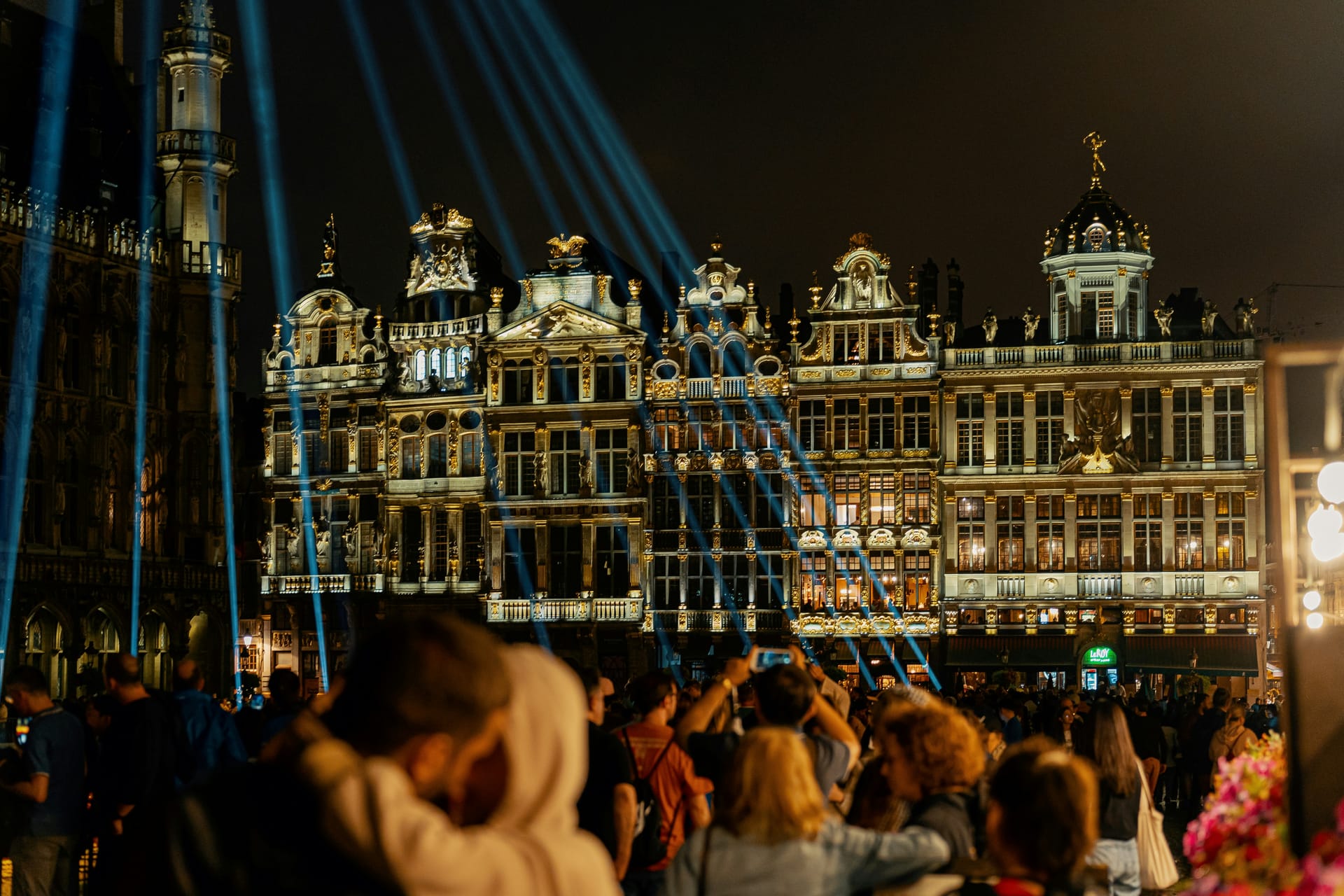
Belgium has 15 UNESCO World Heritage Sites, including the Grand Place of Brussels, the Belfries of Belgium and France, the Historic Centre of Bruges, the Plantin-Moretus Museum (the world’s only printing museum on the UNESCO list), and the Major Mining Sites of Wallonia.
Travel Guide
Entry
Schengen visa-free for 90 days for most Western visitors.
Best Seasons
April-October; the Christmas markets in December are exceptional.
Transport
Belgium has Europe’s densest rail network. SNCB/NMBS trains connect everything; the high-speed Thalys/Eurostar links Brussels to Paris (1h22), London (2h00), and Amsterdam (1h47).
Surprising Facts
- Belgium has the highest beer-style diversity per capita of any country — over 1,500 distinct beers from a population of 11.7 million.3
- Belgian children write to Sinterklaas (Saint Nicholas) for gifts on December 6, not December 25 — the Dutch-Belgian tradition of Sinterklaas predates and parallels the modern Anglo-American Santa Claus.6
- The European Parliament moves between Brussels and Strasbourg twelve times a year for plenary sessions — a logistical anachronism estimated to cost €100 million annually that successive reform attempts have failed to remove.3
- Belgium has compulsory voting — eligible citizens face fines for failing to vote, and voter turnout consistently exceeds 87%.6
- The Atomium — the iconic Brussels structure built for the 1958 World Expo — is a model of an iron crystal magnified 165 billion times.3
- Belgium produces around 220,000 tonnes of chocolate annually — about 19 kg per resident, among the world’s highest chocolate production rates.3
Sources and References
See the list of cited sources in the page frontmatter — UNESCO, World Bank, VisitBelgium, Statbel, National Bank of Belgium, and Encyclopaedia Britannica.