A Volcanic Island the Size of Cuba with the Population of a Small City
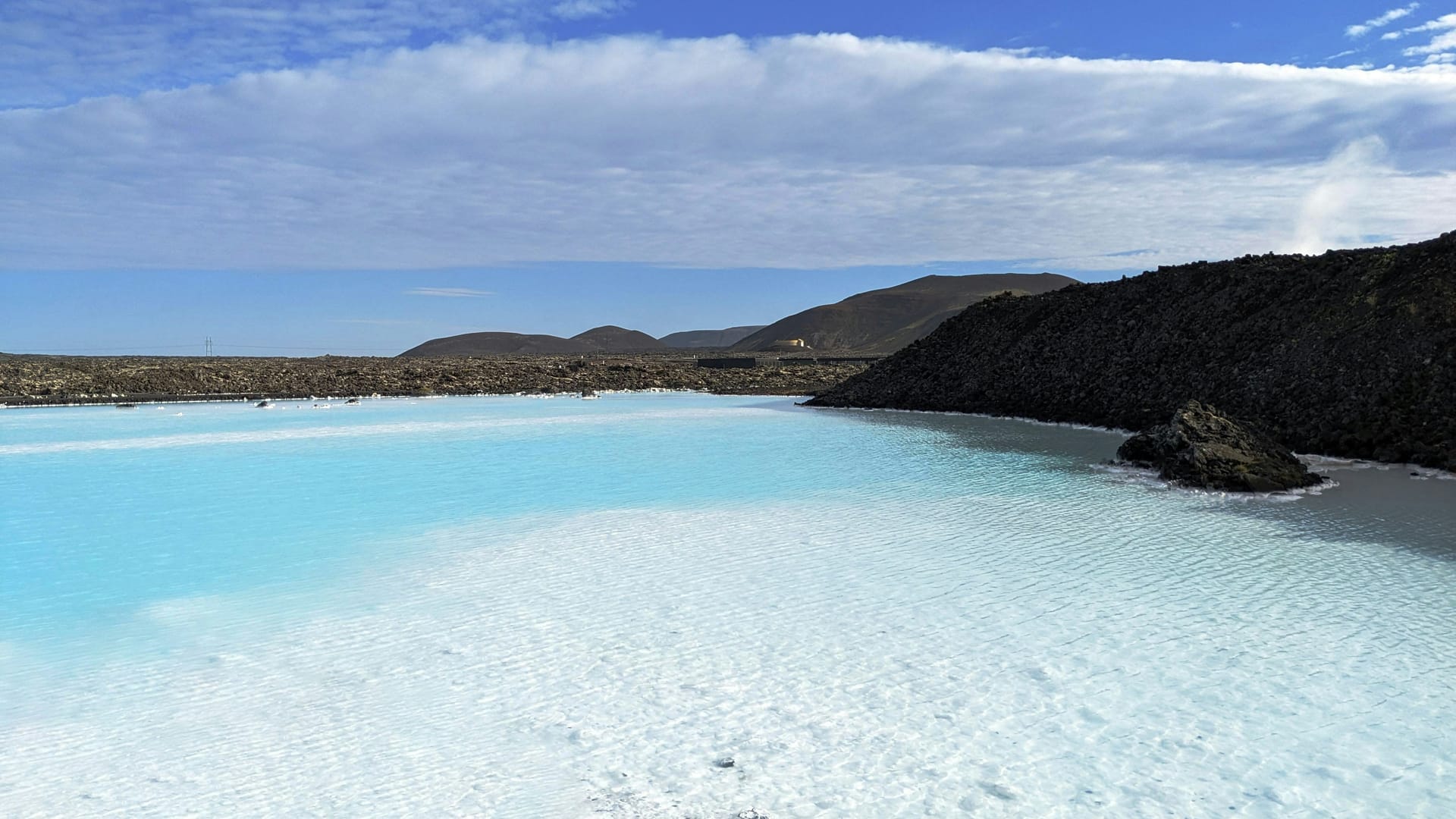
Iceland is one of the most geologically active places on earth — sitting directly on the Mid-Atlantic Ridge, where the North American and Eurasian tectonic plates are slowly pulling apart at a rate of about 2 cm per year. The country has roughly 130 volcanoes, of which 30+ are active; it experiences a major eruption on average every five years. Reykjanes Peninsula, near the international airport, has been in active eruptive cycles since 2021. The terrain is shaped by glaciers covering 11% of the country, lava fields, geothermal hot springs, geysers (the original Geysir gives its name to all the world’s geysers), and dramatic coastal cliffs.
The country also has one of the most distinctive social structures in Europe. Its population of around 390,000 (roughly the size of Pittsburgh, Pennsylvania) supports a fully developed independent state with a parliament dating to 930 AD — the oldest continuously functioning legislative assembly in the world. Icelandic language has changed so little since the medieval Sagas that contemporary Icelanders can read 13th-century texts with difficulty but without translation. All Icelanders share one of about 4,000 commonly recognised family names (most are patronymics — sons of “Jón” become “Jónsson”, daughters become “Jónsdóttir”), and a famous mobile app helps Icelanders check whether a potential romantic partner is too closely related.
Tourism has transformed the country since 2010 — international visitor numbers grew from around 460,000 in 2010 to over 2.2 million in 2023, roughly six times the resident population. The boom has reshaped the economy, generated significant infrastructure stress, and made Iceland one of the most-discussed travel destinations of the past decade.
A Brief History
Settlement
Iceland was settled around 874 AD by Norse Vikings (predominantly Norwegian), with significant Celtic (Irish and Scottish) input from enslaved peoples brought by the settlers. The Althing — the Icelandic national assembly — was founded in 930 AD at Þingvellir.
The Sagas Era
The 9th-12th centuries produced the Icelandic Sagas — prose narratives chronicling the founding settlers’ families and Norse mythology. They are among medieval Europe’s most significant literary achievements and remain widely read in Iceland today.
Foreign Rule
Iceland came under Norwegian rule in 1262, then Danish rule from 1380. The country gained sovereignty in 1918 (in personal union with Denmark) and full independence as a republic in 1944 while Denmark was under Nazi occupation.
The Modern Era
Iceland was a founding member of NATO (1949) but, having no military, contributed no troops. The country joined the EFTA (1970) and the European Economic Area (1994) but is not an EU member.
The 2008 financial crisis hit Iceland exceptionally hard — its three major banks all collapsed in the same week, and the country was briefly bankrupt. Recovery came through tourism (which grew dramatically) and a debt-restructuring approach that controversially let the banks fail rather than bailing them out.
Geography and Climate
Iceland covers 103,000 km² — about the size of Hungary or Indiana — but has a population density of only 3.7 per km² (excluding the capital region, the rest of the country is essentially uninhabited). Roughly 60% of the population lives in the greater Reykjavík area.
Climate
Iceland’s climate is temperate maritime — surprisingly mild for the latitude thanks to the Gulf Stream. Reykjavík averages 11°C in July and -1°C in January. The interior highlands are inhospitable in winter and accessible only in summer.
Culture, Language and Society
Icelandic
Icelandic is one of the most conservative Germanic languages — the modern form is essentially the same as the medieval Old Norse spoken by Vikings. New concepts use Icelandic-rooted neologisms rather than borrowed words (“computer” is tölva, from tala meaning “number” + völva meaning “seer”).
Religion
Iceland is approximately 65% Lutheran (Church of Iceland), with growing unaffiliated and Ásatrú (modern Norse paganism) communities.
The Economy
Iceland’s economy (~$30 billion GDP in 2024) is highly specialised:
- Tourism — around 30% of GDP directly and indirectly
- Fishing — historically dominant (around 4% of GDP), with the country fishing roughly 10 times its own population’s worth of fish per year
- Aluminum smelting — using the country’s abundant cheap geothermal and hydroelectric power
- Geothermal energy — Iceland produces around 70% of its electricity from hydropower and 30% from geothermal sources
Cuisine
Icelandic food reflects scarcity-driven preservation and a recent restaurant renaissance:
- Skyr — Icelandic cultured dairy, similar to Greek yogurt but technically a soft cheese
- Lamb — Icelandic lamb, raised free-range on summer pastures, is exceptionally good
- Fish — cod, haddock, Arctic char, langoustine
- Pylsa — Icelandic hot dogs (Bæjarins Beztu Pylsur in Reykjavík is famous)
- Hákarl — fermented Greenland shark, an acquired taste eaten as a Viking-tradition delicacy
- Plokkfiskur — fish stew with potatoes
Nature and UNESCO Sites
Iceland has 3 UNESCO World Heritage Sites: Þingvellir National Park (the historical assembly site and Mid-Atlantic Ridge), Surtsey (the volcanic island that emerged from the sea in 1963 and has been studied for ecological colonisation), and Vatnajökull National Park (the largest national park in Western Europe).
Travel Guide
Entry
Schengen visa-free for 90 days for most Western visitors.
Best Seasons
- June-August — midnight sun, all roads open including the Highlands F-roads, all whale-watching tours operating, mild weather
- September-March — northern lights season (best September-October and February-March)
- December-February — winter; Ring Road accessible but treacherous; ice caves only available in winter
Transport
The Ring Road (Route 1) circles the entire country (1,332 km) and is the spine of Icelandic tourism. Most visitors rent cars; book well ahead in summer. Domestic flights connect Reykjavík to Akureyri and Egilsstaðir.
Budget
Iceland is extremely expensive — daily mid-range budgets of €200-€350 are typical. Self-catering and camping reduce costs significantly.
Surprising Facts
- Iceland has no army and has never had one — the country relies on NATO membership and a defence agreement with the United States for military protection.6
- The Icelandic naming committee must approve any new given name — to ensure it conforms to Icelandic linguistic conventions.3
- Belief in elves (huldufólk) persists in Icelandic folk culture — road construction projects have occasionally been redirected after consultation with elf experts to avoid disturbing alleged elf habitats.3
- The Icelandic Phallological Museum in Reykjavík displays over 280 penises from various species — and is the only museum of its kind.3
- Iceland has more bookstores per capita than any other country — and one in ten Icelanders will publish a book in their lifetime, the highest rate in the world.3
- Iceland has no mosquitoes — one of the few inhabited landmasses on earth where they are not present.6
Sources and References
See the list of cited sources in the page frontmatter — UNESCO, World Bank, Visit Iceland, Statistics Iceland, Central Bank of Iceland, and Encyclopaedia Britannica.