A Bohemian Heart with Three Centuries of Imperial Inheritance
The Czech Republic — branded internationally since 2016 also as Czechia — is the wealthier, more industrialised, and more globally visible half of the former Czechoslovakia, which split peacefully in 1993 into the Czech Republic and Slovakia. The country occupies the historic regions of Bohemia, Moravia, and a small part of Silesia, with Prague at its political and cultural centre — one of Europe’s most architecturally preserved capitals, having largely escaped the WWII bombing that destroyed many German cities.
Czech identity has been defined by its position at the crossroads of Germanic and Slavic Europe. The country was the cultural heart of the Holy Roman Empire under Charles IV in the 14th century (Prague was the imperial capital from 1346-1437), endured nearly 300 years as a Habsburg province, achieved independence in 1918, suffered Nazi occupation and Communist rule, and emerged in 1989’s Velvet Revolution as one of the most successful democratic transitions of the post-Communist era.
Economic transformation has been equally significant. Czech Republic joined the EU in 2004, and the country’s industrial base — particularly automotive manufacturing — makes it one of Central Europe’s most dynamic economies. Škoda Auto (now part of the Volkswagen Group) is the country’s flagship industrial brand and remains a major regional employer.
A Brief History
Medieval Bohemia
Slavic peoples settled the territory in the 6th-7th centuries. The Premyslid dynasty unified Bohemia in the 9th century. Charles IV (king from 1346, Holy Roman Emperor from 1355) made Prague the imperial capital and founded Charles University (1348) — the first university in Central Europe.
The Hussite Wars
Jan Hus — a religious reformer burned at the stake in 1415, a century before Luther — became the symbolic founder of Czech religious and national identity. The Hussite Wars (1419-1434) were among medieval Europe’s earliest religious conflicts.
Habsburg Centuries
After the Battle of White Mountain in 1620 — a defeat of Bohemian Protestant forces by Catholic Habsburg armies — Bohemia was incorporated into the Habsburg Empire and forcibly re-Catholicised. The country remained Habsburg territory until the empire’s 1918 collapse.
Czechoslovakia and the 20th Century
Czechoslovakia was founded on October 28, 1918, under President Tomáš Masaryk. The country was the most economically developed of the Central European successor states. Nazi annexation of the Sudetenland (1938) under the Munich Agreement, followed by the full occupation of Bohemia and Moravia (1939-1945), ended the inter-war republic. Czechoslovakia fell under Soviet influence after 1948.
The 1968 Prague Spring — Alexander Dubček’s attempt to create “socialism with a human face” — was crushed by Warsaw Pact military intervention. The 1989 Velvet Revolution ended Communist rule peacefully. Czechoslovakia split into two countries on January 1, 1993 in the “Velvet Divorce”.
Geography and Climate
Czech Republic covers 78,866 km² — about the size of South Carolina — and is mostly low rolling hills with small mountain ranges (the Krkonoše/Giant Mountains, the Šumava, the Jeseníky). The country is landlocked, bordered by Germany, Poland, Slovakia, and Austria.
Climate
Continental temperate climate; summers reach 25-30°C, winters around -5°C with snow in mountain regions.
Culture, Language and Religion
Czech is a West Slavic language, mutually intelligible with Slovak and partially with Polish. The Czech Republic is one of Europe’s most secular countries — only about 10% identify as Catholic with regular practice; nearly 70% report no religious affiliation.
The country has produced disproportionate cultural exports: writers (Franz Kafka, Milan Kundera, Václav Havel — the post-Communist president and playwright), composers (Smetana, Dvořák, Janáček), filmmakers (Miloš Forman), and a beer culture so deep that Czechs consume around 130 litres per capita annually — the highest beer consumption in the world for over three decades running.
The Economy
Czech Republic has a highly developed mixed economy (~$340 billion GDP in 2024). Key sectors:
- Automotive — Škoda (VW Group) plus major suppliers; Hyundai, Toyota, and others have plants
- Engineering and machinery
- Brewing — Pilsner Urquell, Budweiser Budvar, Staropramen
- Glass and crystal — Bohemian crystal has 700 years of tradition
- Tech and services — Prague has emerged as a Central European tech hub
Cuisine
Czech cuisine is hearty and meat-heavy, with strong German/Austrian influences:
- Svíčková — beef sirloin in cream sauce with bread dumplings (knedlíky)
- Vepřo-knedlo-zelo — roast pork, dumplings, sauerkraut — the national meal
- Goulash with dumplings
- Trdelník — sweet rolled pastry; tourist-favourite though only popularised in the past 20 years
- Pilsner beer — invented in Plzeň (Pilsen) in 1842
Nature and UNESCO Sites
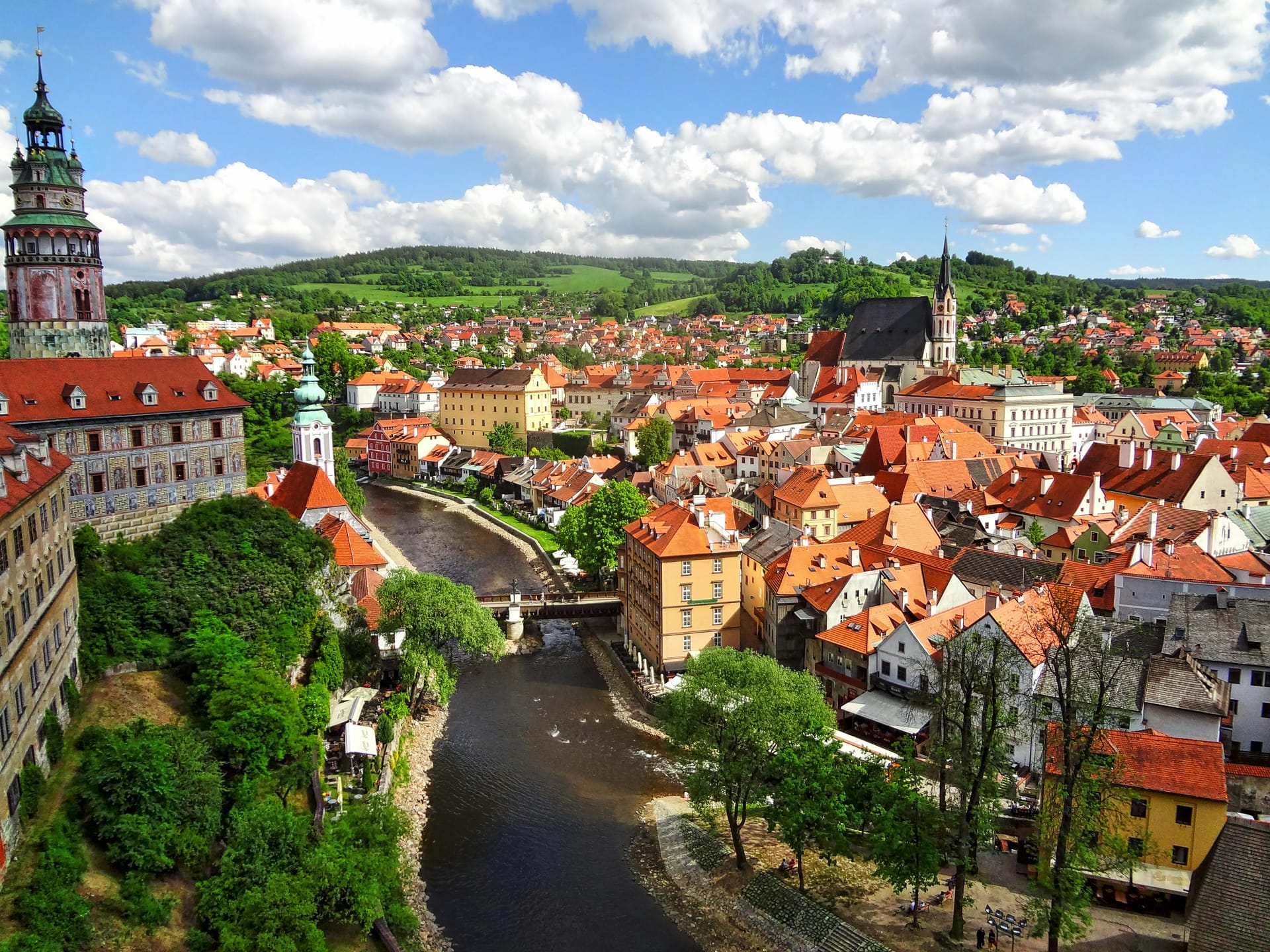
Czech Republic has 17 UNESCO World Heritage Sites, including the Historic Centre of Prague, Český Krumlov, Telč, the Jewish Quarter and Saint Procopius Basilica in Třebíč, Holašovice Historical Village, Karlovy Vary (one of three Great Spa Towns of Europe), and the Pilgrimage Church of Saint John of Nepomuk at Zelená Hora.
Travel Guide
Entry & Best Seasons
Schengen visa-free 90 days. April-October ideal; December for Christmas markets.
Transport
České dráhy trains connect everything; Prague-Brno in 2h30. Long-distance buses (RegioJet) are fast and affordable.
Budget
Mid-range €70-€120 per day; cheaper than Western Europe.
Surprising Facts
- Czechs invented the word “robot” — playwright Karel Čapek used it in his 1920 play R.U.R. (Rossum’s Universal Robots), from the Czech word robota (forced labour).6
- Czech Republic has more castles per square kilometre than any other country — over 2,000 castles, chateaux, and ruins.3
- Pilsner Urquell invented in 1842 was the world’s first golden lager — most beers globally today are descended from this style.3
- Prague’s astronomical clock — installed in 1410 — is the third-oldest in the world and the oldest still operating.6
- Václav Havel went directly from political prison (1989) to the Czech presidency (December 1989).6
- The Sedlec Ossuary in Kutná Hora is decorated with the bones of approximately 40,000 people arranged into chandeliers, family crests, and pyramids by a 19th-century woodcarver.3
Sources and References
See the list of cited sources in the page frontmatter.