The World’s Oldest Continuous Civilisation, Now Its Manufacturing Engine
China is the world’s most populous country (until India overtook it in 2023, by which point Chinese demographics had begun to decline), the world’s second-largest economy, and the only continuously functioning civilisation that has been continuously a single political entity (with intermittent fragmentation) for over 3,500 years. The country’s defining historical fact is its sheer scale and continuity — the Mandarin language spoken today shares roots with the language of the Shang Dynasty (1600-1046 BC); the bureaucratic system that runs modern China traces back to the Han Dynasty (206 BC-220 AD); the imperial examinations that produced China’s scholar-officials lasted from the 7th to the 20th centuries.
Modern China — the People’s Republic of China, founded by Mao Zedong on October 1, 1949 — has undergone the most dramatic economic transformation in human history. Between 1980 and 2020, China lifted approximately 800 million people out of poverty, raised its GDP per capita roughly fortyfold, and transformed itself from an agricultural society into the world’s manufacturing powerhouse and a major global investor in infrastructure and technology. Xi Jinping, who has led the Communist Party since 2012 and removed the constitutional term limits in 2018, has overseen the country’s emergence as a global geopolitical player rivalling the United States.
Tourism within China and from China abroad has both grown enormously. Chinese cultural reach — through cuisine, film (the box office is now larger than the US), tech (Tencent, Alibaba, ByteDance/TikTok, Huawei), and a diaspora numbering perhaps 60 million — shapes much of contemporary Asia and increasingly the world.
A Brief History
Imperial China
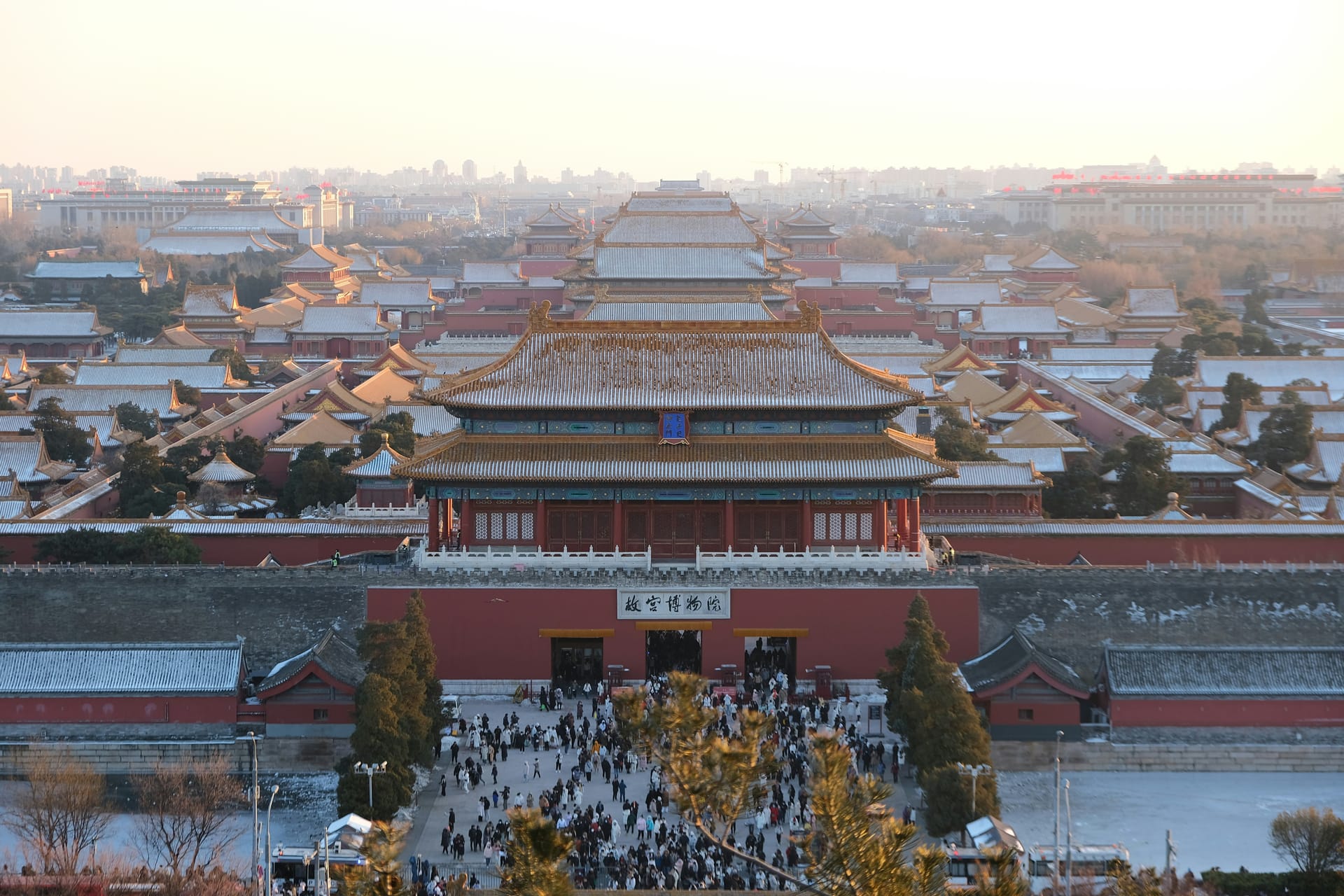
Chinese history is conventionally organised around dynasties. The earliest documented dynasty is the Shang (c. 1600-1046 BC), with the Xia sometimes earlier (less archaeologically attested). The Qin Dynasty (221-206 BC) under Qin Shi Huang unified China for the first time and constructed early sections of the Great Wall. The Han (206 BC-220 AD) established the lasting cultural and administrative templates of Chinese civilisation. The Tang (618-907) is often considered the cultural zenith — the Silk Road’s peak, the era of Li Bai’s poetry, the spread of Buddhism. The Song (960-1279) brought economic and technological innovation. The Yuan (1271-1368) was Mongol rule under Kublai Khan. The Ming (1368-1644) built the Forbidden City and the most famous Great Wall sections. The Qing (1644-1912) was the last imperial dynasty, ethnically Manchu rather than Han Chinese.
The Republic and the Civil War
The 1911 Xinhai Revolution ended imperial China; the Republic of China (1912-1949) was politically chaotic, with regional warlords, the Northern Expedition’s reunification under Chiang Kai-shek, and the long Chinese Civil War between the Nationalists (Kuomintang) and Communists. Japanese invasion (1937-1945) in WWII killed an estimated 15-20 million Chinese.
The Communists under Mao Zedong won the civil war; the People’s Republic was proclaimed in October 1949. The Nationalists retreated to Taiwan.
Mao Era
Mao’s tenure produced the catastrophic Great Leap Forward (1958-1962) — agricultural collectivisation that triggered famine killing an estimated 15-45 million people — and the Cultural Revolution (1966-1976) — political and cultural purges that killed hundreds of thousands and destroyed enormous historical patrimony.
Reform and Opening
Deng Xiaoping launched economic reforms in 1978 that began China’s transformation. The famous formulation “socialism with Chinese characteristics” allowed gradual marketisation while maintaining single-party rule. The 1989 Tiananmen Square protests — and their violent suppression — set hard limits on political liberalisation.
Modern China
Subsequent decades brought sustained 8-10% annual GDP growth, WTO accession (2001), the 2008 Beijing Olympics, and the rise to status as the world’s second-largest economy. Xi Jinping has consolidated power, intensified ideological control, launched the Belt and Road Initiative (a global infrastructure investment programme), and presided over significant tensions with the US, Japan, India, and Taiwan.
Geography and Climate
China covers 9,596,961 km² — the world’s third or fourth-largest country by area — spanning every climate zone from subarctic (Heilongjiang) to subtropical (Hainan) to true desert (Xinjiang) to high-altitude (Tibet). The country has 22 provinces, 5 autonomous regions, 4 directly-controlled municipalities (Beijing, Shanghai, Tianjin, Chongqing), and 2 special administrative regions (Hong Kong, Macau).
Climate
Eastern China has a continental climate with monsoonal summer rains; the southwest is subtropical; the northwest is arid desert; Tibet is alpine.
Culture, Language and Religion
Mandarin Chinese (Putonghua) is the official language. Major regional Chinese languages — Cantonese (Guangdong, Hong Kong), Shanghainese, Hokkien, Hakka, Min — are mutually unintelligible with Mandarin in spoken form but share the same written characters.
China has 56 officially recognised ethnic groups; the Han Chinese are roughly 91% of the population, with significant minorities including Zhuang, Hui (Muslim Chinese), Uyghur, Manchu, Tibetan, and Mongol.
Officially atheist; in practice, Buddhism, Taoism, Confucian-derived ancestor veneration, Christianity, and Islam are all practised, with varying degrees of state regulation.
The Economy
China has the world’s second-largest economy by nominal GDP (~$18 trillion in 2024) and the largest by purchasing power parity. The country is the world’s largest manufacturer, largest exporter, largest holder of US Treasury bonds, and largest auto market.
Key sectors: manufacturing (electronics, EVs — BYD overtook Tesla in 2023, machinery, textiles, chemicals), technology (Huawei, Tencent, Alibaba, ByteDance, Xiaomi), construction, finance, infrastructure.
The country’s growth has slowed in recent years; demographic decline (population fell in 2022 and 2023), property-sector debt issues (Evergrande default in 2021), and youth unemployment are key concerns.
Cuisine
Chinese cuisine is one of the world’s most varied, with eight distinct regional traditions (Cantonese, Sichuan, Hunan, Shandong, Jiangsu, Zhejiang, Fujian, Anhui) plus countless local variations:
- Cantonese — light, fresh, dim sum; the cuisine most familiar internationally
- Sichuan — fiery hot, with the unique numbing sensation of Sichuan peppercorn
- Beijing — Peking duck, hand-pulled noodles
- Shanghai — sweet, soy-glazed, xiao long bao soup dumplings
Nature and UNESCO Sites
China has 57 UNESCO World Heritage Sites — the second-most globally after Italy. Highlights include the Great Wall, the Forbidden City, Terracotta Army at Xi’an, Potala Palace in Lhasa, Mount Wuyi, Huangshan, Jiuzhaigou Valley, and the Mausoleum of the First Qin Emperor.
Travel Guide
Entry
Visa requirements have changed substantially in 2024 — many nationalities can now enter China visa-free for short visits. Check current requirements before booking.
Best Seasons
April-May and September-October are the optimal windows (avoid Chinese New Year and the October Golden Week if you don’t enjoy crowds).
Transport
China has the world’s largest high-speed rail network (45,000+ km). Beijing-Shanghai is 4h28; Beijing-Hong Kong is 8 hours.
Budget
Mid-range $80-$160 per day in major cities.
Surprising Facts
- The Great Wall of China is, contrary to popular belief, not visible from space with the naked eye — it’s too narrow.6
- Chinese is the world’s most-spoken native language — over 1.1 billion native speakers (mostly Mandarin).4
- WeChat — China’s dominant messaging app — also handles payments, bills, transport, food orders, and government services for over 1.3 billion users.3
- China has the world’s largest high-speed rail network at over 45,000 km — more than the rest of the world combined.4
- Pandas — the iconic Chinese symbol — exist almost exclusively in the wild in the bamboo forests of Sichuan, Shaanxi, and Gansu provinces; only around 1,800 remain in the wild.1
- The Chinese government blocks Google, Facebook, Instagram, X (Twitter), YouTube, WhatsApp, and many other Western services through what is colloquially called the Great Firewall of China.6
Sources and References
See the list of cited sources in the page frontmatter.