The World’s Second-Largest Country, with the Population of California
Canada is the second-largest country on earth by area — 9.98 million square kilometres, slightly larger than China — but with only 40.8 million people, fewer than California. The country occupies the entire northern half of North America between the Atlantic and Pacific Oceans, including 90% of all freshwater lakes in the world (the Great Lakes, which it shares with the US, are visible from space) and an Arctic territory that includes the world’s largest archipelago. About 70% of Canadians live within 150 km of the US border — the rest of the country is mostly uninhabited boreal forest, tundra, and the Arctic.
What Canada has done with this geography is build one of the world’s most successful examples of a deliberately multicultural society. The country accepts immigrants at one of the highest per-capita rates of any developed nation; 23% of Canadians are foreign-born (the highest share among G7 countries); languages other than English or French are spoken in roughly 22% of homes. The Canadian model — multiculturalism enshrined in the 1982 Constitution and the 1988 Multiculturalism Act, with active integration support and high immigration intake — has been studied closely by other countries facing demographic transition.
Politically, Canada is a constitutional monarchy and parliamentary democracy that retains the British monarch as head of state through a Governor General; functionally a country governed by Parliament in Ottawa, with substantial provincial autonomy (especially Quebec, where the question of independence shaped 50 years of Canadian politics). The country is bilingual at the federal level (English and French) and officially bilingual provinces are New Brunswick and federal institutions.
A Brief History
Indigenous Canada
The territory now called Canada has been inhabited by First Nations, Inuit, and Métis peoples for at least 15,000-30,000 years. Pre-contact populations are estimated at 500,000 to 2 million. Indigenous societies ranged from the highly stratified maritime cultures of the Pacific Northwest (Haida, Kwakwaka’wakw, Tlingit), to the agricultural Iroquoian and Algonquian peoples of the eastern woodlands, to the nomadic Plains nations (Cree, Blackfoot), to the Inuit of the Arctic.
European Contact
Norse Vikings established a brief settlement at L’Anse aux Meadows in Newfoundland around 1000 AD — the only confirmed pre-Columbian European settlement in the Americas — but did not stay. Sustained European contact began with John Cabot’s voyage in 1497 for the English Crown and Jacques Cartier’s voyage in 1534 for the French Crown. Samuel de Champlain founded Quebec City in 1608, establishing New France.
French and British North America
New France included most of the St. Lawrence valley, the Great Lakes region, and a vast Mississippi-watershed claim. France lost most of these territories to Britain in the Seven Years’ War (1756-1763); Quebec fell after the 1759 Battle of the Plains of Abraham. Britain administered French Canada with significant accommodation of French language, civil law, and Catholic religion through the 1774 Quebec Act — a policy that helped keep Quebec loyal during the 1775 American Revolution.
Confederation and Westward Expansion
The British North America Act of 1867 united Ontario, Quebec, New Brunswick, and Nova Scotia into the Dominion of Canada, with subsequent additions of Manitoba (1870), British Columbia (1871), Prince Edward Island (1873), Alberta and Saskatchewan (1905), and Newfoundland (1949). The Canadian Pacific Railway completed in 1885 physically tied the country together.
The Twentieth Century
Canada fought alongside Britain in both World Wars at significant cost (66,000 dead in WWI, 45,000 in WWII). The Statute of Westminster of 1931 granted Canada full legislative autonomy from the UK. The 1982 Constitution Act patriated the Constitution and added the Canadian Charter of Rights and Freedoms — Canada’s bill of rights, central to subsequent constitutional jurisprudence.
Quebec and Beyond
The Quiet Revolution in Quebec during the 1960s transformed the province from a Catholic-conservative society into a secular, modernised one with a strong distinct national identity. Two referendums on Quebec independence (1980 and 1995) failed — the 1995 vote by less than 1% — but the issue continues to shape Canadian politics. Quebec remains constitutionally distinct, with French as its sole official language and significant policy autonomy.
Recent Decades
Canada’s recent decades have been shaped by immigration-driven demographic transformation, resource extraction debates (especially Alberta oil sands and pipeline politics), Indigenous reconciliation efforts (including the Truth and Reconciliation Commission, 2008-2015, which documented residential school abuses), climate policy struggles, and Canada’s positioning between the US (its dominant trading partner) and a more multipolar world.
Geography and Climate
Canada covers 9,984,670 km² — second only to Russia. The country has six time zones, two oceans plus an Arctic third coastline, and contains some of the world’s most dramatic landscapes alongside vast areas of subarctic forest and tundra.
Regional Geography
- The Atlantic Provinces — Newfoundland and Labrador, Nova Scotia, New Brunswick, Prince Edward Island. Maritime culture, fishing economy, the easternmost point in North America.
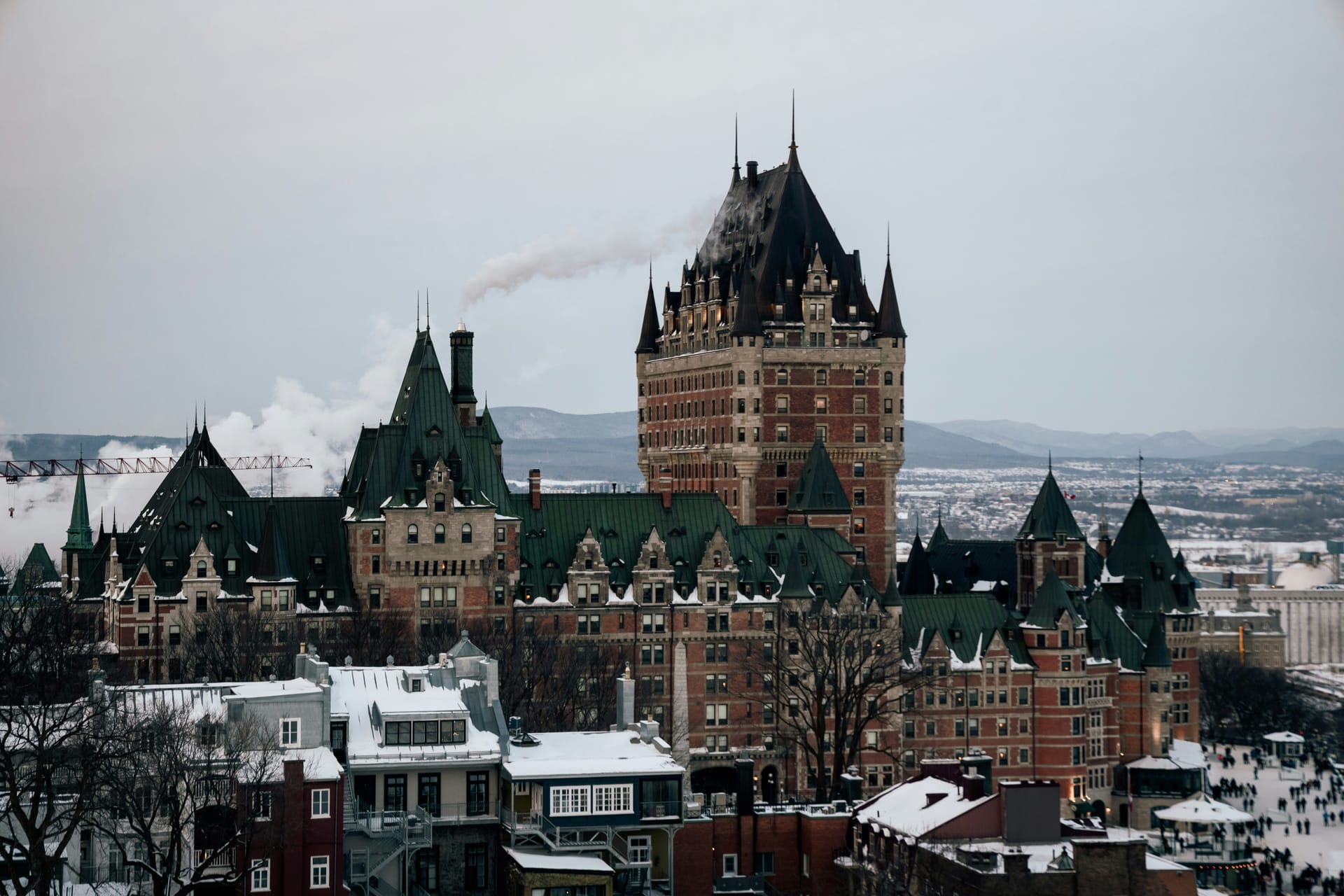
- Quebec — French-speaking, with Montreal (Canada’s second-largest city), Quebec City (the historic provincial capital), the Laurentian Mountains, and the vast subarctic territory north of the populated south.
- Ontario — most populous province, including Toronto (Canada’s largest city), Ottawa (the federal capital), the Great Lakes shorelines, and Niagara Falls.
- The Prairies — Manitoba, Saskatchewan, Alberta. Wheat, beef, oil and gas, the Rocky Mountain foothills.
- British Columbia — Pacific coast, with Vancouver (Canada’s third-largest city), Victoria, and the rugged inside-passage coastline up to Alaska.
- The North — Yukon, Northwest Territories, Nunavut. Sparsely populated (Nunavut has 36,000 people across 2 million km²), with strong Indigenous presence.
Climate
Canada’s climate ranges from temperate maritime (Vancouver) to continental (most of southern Canada, with hot summers and cold winters) to subarctic (much of the boreal forest zone) to arctic (the far north). Toronto has January averages around -4°C; Winnipeg -16°C; Iqaluit -27°C. Canadian winter cold is real and unforgiving in the interior; Vancouver’s mild Pacific climate is the obvious exception.
Wilderness
Canada has 48 national parks and reserves, plus extensive provincial parks. The country contains 9% of the world’s renewable freshwater supply, the world’s largest boreal forest, and the High Arctic — including Quttinirpaaq National Park at the northern tip of Ellesmere Island, less than 800 km from the North Pole.
Culture, Language and Society
English and French Canada
Canada’s two official languages reflect a founding cultural duality that has shaped the country since the 1759 conquest. Roughly 75% of Canadians speak English as a first language; 22% speak French (almost all in Quebec, with smaller communities in New Brunswick and Ontario). Bilingualism is a federal policy — government services, signage on federal property, and high-level political careers require functional French.
Quebec Distinctiveness
Quebec functions almost as a country within Canada. French is the sole official provincial language; the civil law tradition (rather than common law as in the rest of Canada) governs private legal matters; education and culture are heavily provincially regulated. The province’s distinct identity has been a constant theme of Canadian politics for over a century.
Multiculturalism
Multiculturalism is constitutionally enshrined in Canada (Section 27 of the Charter). The 2021 census recorded that 23% of Canadians were foreign-born — the highest among G7 countries. Major immigrant origins include India, China, the Philippines, Iran, Pakistan, the UK, the US, Syria, France, and Vietnam. Toronto and Vancouver are among the world’s most diverse cities by foreign-born population share.
Indigenous Reconciliation
The Truth and Reconciliation Commission’s 94 Calls to Action (2015) framed Canada’s ongoing reconciliation work with Indigenous peoples — addressing residential school abuses, treaty implementation, language revitalisation, and Indigenous self-government. Progress is uneven; the discovery of unmarked graves at former residential school sites in 2021-2022 intensified national reflection.
Sport
Ice hockey is Canada’s defining sport — the country has won the most Olympic gold medals in men’s hockey and produced the largest share of NHL players. Canadian football (a variant of American football, with three downs and a larger field) is the national gridiron sport. Curling, lacrosse, soccer, and basketball all have significant followings.
The Economy
Canada has the ninth-largest economy in the world by nominal GDP (~$2.2 trillion in 2024) and is a member of the G7. The economy is broadly diversified — services, manufacturing, natural resources, finance, and technology all contribute meaningfully.
Key Sectors
- Natural resources — Canada is a major exporter of oil and natural gas (Alberta has the world’s third-largest proven oil reserves, mostly in the bitumen-rich oil sands), minerals (potash, uranium, nickel, gold, aluminum), and timber.
- Automotive — Ontario hosts assembly plants for Ford, GM, Stellantis, Toyota, and Honda.
- Aerospace — Bombardier, CAE, MDA Space.
- Financial services — Toronto’s Bay Street is the country’s financial centre; the Big Five Canadian banks (RBC, TD, Scotiabank, BMO, CIBC) are among North America’s largest.
- Technology — Canadian tech has grown significantly. Shopify, OpenText, BlackBerry’s reinvention as security software, and a strong AI research community (the Vector Institute in Toronto, MILA in Montreal — Canadian researchers contributed substantially to the deep learning revolution).
- Agriculture — Canada is the world’s largest producer of canola, a top wheat exporter, and significant in lentils, beef, pork, and dairy.
US Trade Dependency
The US is Canada’s dominant trading partner — roughly 75% of Canadian exports go south. The Canada-US-Mexico Agreement (CUSMA, the successor to NAFTA) governs the trade relationship. Periodic US trade tensions — Trump-era steel and aluminum tariffs, automotive content rules, the Keystone XL pipeline cancellation — have driven discussions about trade diversification, with mixed success.
Healthcare
Canada has a publicly funded universal healthcare system (single-payer, provincially administered) — one of the country’s most cherished public institutions. The Canada Health Act sets national standards; the system is regularly compared favourably with the US system on coverage and cost outcomes, less favourably on wait times.
Cuisine
Canadian cuisine has historically been overshadowed by US influence and a self-deprecating national reputation, but the country has distinctive regional traditions and a contemporary restaurant scene that punches above its weight in major cities.
Iconic Dishes
- Poutine — the Quebec invention of fries, cheese curds, and gravy. Now a national symbol with countless restaurant variations.
- Maple syrup — Canada produces about 75% of the world’s maple syrup, mostly in Quebec. The annual sugar shack (cabane à sucre) tradition is a Quebec spring ritual.
- Tourtière — Quebec’s traditional meat pie, eaten at Christmas and New Year.
- Bannock — a flat bread of Indigenous and Scottish heritage, deep in Canadian food history.
- Butter tarts — pastry shells filled with a buttery, sugary filling. Ontario claims them.
- Nanaimo bars — three-layered British Columbia dessert (graham crumb base, custard middle, chocolate top).
- Montreal-style bagels — hand-rolled, boiled in honey-water, baked in wood-fired ovens. Distinctly different from New York bagels.
- Smoked meat — Montreal’s signature deli meat, with Schwartz’s being the most famous purveyor.
- Ketchup chips and all-dressed chips — Canadian potato chip flavours rare or absent elsewhere.
Regional Cuisines
- Atlantic Canada — extensive seafood (lobster from PEI and Nova Scotia, snow crab, scallops, oysters), seal meat in Newfoundland, fish and brewis.
- Quebec — French-influenced cooking, the country’s strongest cheese tradition, foie gras producers, the modern Montreal restaurant scene (Joe Beef, Au Pied de Cochon).
- Prairie — strong beef, bison, perogies (from Ukrainian-Canadian heritage), Saskatoon berries.
- Pacific Northwest — salmon (especially sockeye), Dungeness crab, spot prawns, BC wines from the Okanagan Valley.
Nature and UNESCO Sites
Canada has 22 UNESCO World Heritage Sites, with significant natural site strength:
- Nahanni National Park — subarctic wilderness in the Northwest Territories, the first natural site inscribed (1978)
- Dinosaur Provincial Park — Alberta, one of the world’s richest dinosaur fossil fields
- Kluane / Wrangell-St. Elias / Glacier Bay / Tatshenshini-Alsek — shared with the US, the world’s largest non-polar ice field
- Canadian Rocky Mountain Parks — Banff, Jasper, Yoho, Kootenay, Mount Robson, Mount Assiniboine, Hamber
- Gros Morne National Park — Newfoundland, fjords and exposed earth mantle
- Wood Buffalo National Park — Canada’s largest national park, the last remaining nesting habitat of the whooping crane
- Old Town Lunenburg — Nova Scotia, the best-preserved British colonial town in North America
- Quebec City Historic District
- L’Anse aux Meadows National Historic Site — the Norse Viking settlement
- Head-Smashed-In Buffalo Jump — Alberta, Indigenous bison-hunting site
- Pimachiowin Aki — Anishinaabe cultural landscape
National Parks System
Canada has 48 national parks managed by Parks Canada. Major destinations include Banff (Canada’s first, founded 1885), Jasper, Yoho, Pacific Rim, Cape Breton Highlands, Algonquin (Ontario provincial park, often included), and the Arctic parks.
Travel Guide: Practical Information
Entry
US citizens can enter Canada with a passport and don’t need a visa. UK, EU, Australian, Japanese, South Korean visitors need an Electronic Travel Authorization (eTA) — CAD $7, valid 5 years, applied for online before flying. Requirements vary; check current Government of Canada immigration website before booking.
Best Seasons
- June-September — the universal best window for Canada. All regions are accessible, the parks are at peak, daylight is long (the far north has midnight sun in late June).
- September-October — autumn colours in Quebec, Ontario, and the Maritimes. Spectacular and less crowded than summer peak.
- December-March — ski season in the Rockies (Whistler, Banff, Lake Louise) and Quebec; northern lights season in Yukon and Northwest Territories. Cold and short days everywhere except Vancouver.
- April-May — “shoulder season” with melting snow; not ideal everywhere.
Transport
- Domestic flights — Air Canada and WestJet are the major carriers. Toronto-Vancouver is 5 hours; Toronto-Montreal is 1.5 hours; Vancouver-Calgary is 1.5 hours.
- VIA Rail — passenger rail network. The Canadian train Vancouver-Toronto (4 days) is one of the world’s great rail journeys; the Toronto-Quebec City corridor has more frequent service.
- Rental cars — essential for the Rockies, the Maritimes, and most park visits. Highway distances are vast; Toronto-Vancouver by car is a 4-day drive minimum.
- Urban transit — Toronto, Montreal, and Vancouver all have decent metro/transit systems.
Budget
Canada is moderately expensive — daily mid-range budgets of CAD $200-$350 are typical (US $145-$255). Major cities cost roughly the same as the US; rural Canada is cheaper. Tipping at restaurants is 15-20%, similar to the US.
Etiquette
- Politeness is real, not a stereotype. “Sorry” is used widely as social lubricant.
- Tipping matters — see above.
- Indigenous land acknowledgements are increasingly common at public events; this is a meaningful cultural shift to recognise.
- Quebec — even basic French (bonjour, merci, s’il vous plaît) is appreciated, particularly outside Montreal.
Surprising Facts
- Canada has more lakes than the rest of the world combined — by some count, over 2 million lakes within Canadian borders, holding 20% of the world’s surface freshwater.6
- The Quebec language laws require commercial signage to display French more prominently than other languages, leading some international brands to use French names exclusively in Quebec (KFC is “PFK” — Poulet Frit Kentucky — only in Quebec).6
- Canada’s national motto — A mari usque ad mare (Latin for “from sea to sea”) — was adopted in 1921 and refers to the Atlantic-Pacific span; the country’s three oceans (including the Arctic) make it geographically inaccurate.6
- The Canadian flag with the maple leaf was adopted only in 1965 — before that, Canada used the Red Ensign with a Union Jack in the corner. The maple leaf design was selected after extensive parliamentary debate.6
- Hockey is Canada’s official winter sport, lacrosse the official summer sport — both legally designated, with lacrosse in particular being a sport of Indigenous origin formally recognised since 1994.3
- Canada has 6 time zones — Newfoundland Time (UTC-3:30), Atlantic, Eastern, Central, Mountain, and Pacific. The Newfoundland half-hour offset is a quirk of the colony’s separate development from the rest of Canada.6
Sources and References
See the list of cited sources in the page frontmatter — UNESCO, World Bank, Destination Canada, Statistics Canada, Bank of Canada, Encyclopaedia Britannica, and Parks Canada.