A Continent with 26 Million People
Australia is the only country in the world that is also a continent in its own right — a 7.7 million km² landmass (slightly smaller than the contiguous 48 US states) with a population roughly equal to that of metropolitan Paris. That extreme ratio of land to people is not incidental; it is the defining fact of the country. The vast, largely uninhabited interior — the Outback — exerts an outsized influence on Australian self-image, though 85% of Australians live within 50 kilometres of the coast.
Before British arrival in 1788, Australia was home to Aboriginal and Torres Strait Islander peoples who had developed the world’s oldest continuous cultures — archaeological evidence places their arrival on the continent at least 65,000 years ago, making Australian Indigenous cultures the longest uninterrupted cultural traditions in human history. Modern Australia is in the middle of a long, uncomfortable reckoning with what that history means and how to acknowledge it constitutionally and practically.
What the country produced in the 237 years since British colonisation is equally distinctive: one of the world’s most successful immigrant societies (30% of Australians were born overseas), a political culture that rewards practical competence more than rhetoric, a cuisine that has absorbed East Asian, Southern European, and Middle Eastern influences more thoroughly than perhaps any comparable country, and a peculiar sporting tradition in which Australian Rules Football dominates the south, rugby league dominates the east, and cricket somehow unifies both.
A Brief History
Indigenous Australia
The Aboriginal peoples and Torres Strait Islanders have occupied Australia continuously for at least 65,000 years — a period long enough to encompass the last ice age and the rise and fall of most of the archaeological cultures Europeans study in their own countries. Before British arrival, Indigenous Australia was linguistically diverse (over 250 distinct language groups), economically adapted to an exceptionally difficult continent, and organised through complex kinship systems and songlines (tracks of creation stories mapping the land). The population in 1788 is estimated at 750,000 to 1.25 million.
British Colonisation
British colonisation began with the First Fleet of 1788, which established a penal colony at Port Jackson (now Sydney). Until 1868, about 162,000 convicts were transported from Britain and Ireland to Australian colonies — a larger forced migration than the transatlantic slave trade in some years. Free settlers and gold-rush migration after 1851 transformed the population; the six British colonies (New South Wales, Victoria, Queensland, South Australia, Western Australia, Tasmania) were federated into the Commonwealth of Australia on 1 January 1901.
The Dispossession
The colonial period was catastrophic for Indigenous peoples. Smallpox and other introduced diseases killed perhaps 50-70% of the Aboriginal population within two generations. Frontier violence, forced removal from land, and the Stolen Generations (government-backed removal of mixed-race Indigenous children from their families, from 1910 to the 1970s) produced lasting trauma that the country is still processing. A 2017 referendum on constitutional recognition failed narrowly; an Indigenous Voice to Parliament referendum failed in 2023.
The 20th and 21st Centuries
Australia fought alongside Britain in both World Wars (Gallipoli in 1915 remains the country’s foundational military myth). The post-war Colombo Plan and the 1973 abandonment of the White Australia policy opened the country to Asian immigration; subsequent decades have seen Australia transform from a predominantly British-descent society into one of the world’s most ethnically diverse. The country’s economy has pivoted from agriculture to mining to services, with strong trade links to China becoming both an economic driver and a source of geopolitical anxiety.
Geography and Climate
Australia covers 7,692,024 km² and is the world’s sixth-largest country. The continent is astonishingly flat and geologically stable — there are no active volcanoes on the mainland, earthquakes are rare and mild, and the highest mountain (Mount Kosciuszko at 2,228 metres) is lower than the tallest mountain in France.
Regional Geography
- The Eastern Seaboard — Sydney, Brisbane, Melbourne, Canberra, Adelaide. Where 75% of Australians live. Includes the Great Dividing Range, the Blue Mountains, and the Great Barrier Reef off Queensland.
- The Red Centre — Alice Springs, Uluru, Kings Canyon. The continent’s arid interior, with red-soil deserts punctuated by ancient monoliths.
- The Top End — Darwin, Kakadu National Park, Arnhem Land. Tropical north, monsoonal climate, significant Indigenous communities.
- Western Australia — Perth and the vast, mostly empty west. Mining economy, wildflower country, and the remote Kimberley region.
- Tasmania — the island state south of the mainland. Cool temperate climate, forested wilderness, a distinct culinary and wine scene that has flourished since the 2000s.
Climate Zones
Australia spans tropical (north), arid (centre), subtropical (east coast), oceanic (southeast), and Mediterranean (southwest) climate zones. The country has seven climate zones in Köppen terms — more than any other country outside Russia.
Fire and Flood
Australian climate is defined by extremes. The Black Summer bushfires of 2019-2020 burned 24 million hectares, killed 34 people directly plus hundreds more from smoke exposure, and destroyed an estimated three billion animals. Flooding events in Queensland and New South Wales have repeatedly displaced tens of thousands since 2020. Climate change has measurably intensified both fire and flood risk.
Unique Wildlife
Australia’s 50-million-year isolation from other continents produced a uniquely distinct fauna — kangaroos, koalas, wombats, platypus, echidnas, Tasmanian devils, cassowaries — and some of the world’s most dangerous wildlife, with the top ten most venomous snakes all found here. The continent has the highest mammalian extinction rate of any country since European colonisation.
Culture, Society and Language
The Multicultural Society
Australia’s demographic transformation since 1970 is one of the most rapid of any developed country. About 30% of Australian residents were born overseas — among the highest proportions in the world outside the Gulf states — with the largest foreign-born populations coming from the UK, India, China, New Zealand, the Philippines, and Vietnam. The country’s major cities are genuinely multicultural in a way that the 1970s stereotype of white Australia no longer fits.
Aboriginal Culture
Indigenous languages and cultural practices are increasingly recognised and taught, though the dispossession of the colonial era remains a live political issue. NAIDOC Week (July), Sorry Day (26 May, commemorating the Stolen Generations), and Australia Day / Invasion Day (26 January, contested) are key calendar markers. The Welcome to Country ceremony — an acknowledgement of Indigenous custodianship — is now standard at public events.
The Language
Australian English has its own vocabulary and a famously laconic sensibility. Words like “arvo” (afternoon), “bogan” (rough local), “servo” (petrol station), “thongs” (flip-flops), and “mate” (used for everyone regardless of actual friendship) mark the dialect. The rising terminal — a rising intonation at the end of statements — has been exported globally through Australian television.
Sport
Sport is central to Australian social life. Australian Rules Football (AFL) dominates Melbourne, Adelaide, Perth, and much of the south and west. Rugby League (NRL) dominates Sydney, Brisbane, and the eastern seaboard. Cricket unifies the country in summer. Rugby Union, soccer, netball, tennis, swimming, and surfing all have strong followings. The AFL Grand Final and the NRL Grand Final are national institutions, and winning the Ashes (the cricket series against England) produces genuine national rejoicing.
The Economy
Australia has the world’s 13th-largest economy by nominal GDP (~$1.7 trillion in 2024), and among the highest GDP per capita in the world ($67,000+). The country has now gone over 30 years without a recession (a streak broken only briefly by the COVID-19 pandemic), the longest continuous growth among developed economies.
Key Sectors
- Mining — Australia is one of the world’s largest exporters of iron ore (mostly to China), coal, gold, lithium, and rare earths. Mining accounts for roughly 10% of GDP and a disproportionate share of exports.
- Agriculture — wheat, beef, wool, lamb, dairy, wine. Australia is the world’s largest exporter of beef and one of the largest wool producers.
- Services — financial services (dominated by the “Big Four” banks: Commonwealth, Westpac, ANZ, NAB), higher education (international students contribute ~$40 billion annually), professional services, and tourism.
- Tourism — around 8 million international visitors in 2023, contributing ~3% of GDP.
The China Dependency
The Australian economy is exceptionally dependent on Chinese demand for raw materials — roughly 35% of Australian exports go to China. The 2020-2022 period of political tension between the two countries saw Chinese tariffs on Australian wine, barley, and beef, though trade has since largely normalised. The relationship is economically critical but strategically uncomfortable.
Cost of Living
Australia has a famously high cost of living — Sydney and Melbourne regularly rank in the world’s top 15 most expensive cities. Housing costs in particular have risen sharply relative to wages since 1990, creating generational tension around home ownership.
Cuisine
Australian cuisine has undergone a quieter transformation than most countries in the past 40 years, moving from a British-derived meat-and-three-veg tradition to one of the world’s most successfully integrated fusion cuisines. The country’s position — immigrant-rich, geographically close to Asia, with excellent produce — has produced restaurants in Sydney and Melbourne that regularly rank in global top 50 lists.
Foundational Elements
- Sunday barbecue — a cultural ritual, typically involving sausages, steak, lamb chops, and prawns grilled on a gas barbie.
- Meat pies and sausage rolls — pub staples, still the default footy food.
- Vegemite — the yeast-extract spread that divides visitors sharply. A thin scraping on buttered toast is the correct dose.
- Fish and chips — coastal takeaway tradition.
Asian-Australian Fusion
The distinctive modern Australian restaurant tradition — exemplified by David Thompson’s Long Chim, Tetsuya Wakuda’s work, Momofuku Seiōbo, and countless Sydney and Melbourne restaurants — fuses Chinese, Thai, Vietnamese, Japanese, Korean, and Indian techniques with Australian produce. Laksa, pho, dumplings, banh mi, and Thai curries are now as Australian as a meat pie.
The Coffee Culture
Melbourne arguably has the world’s most advanced coffee culture outside Italy. The flat white — an espresso-based drink with steamed milk, invented either in Sydney or Auckland (the debate remains unresolved) — has been exported globally. Australian coffee chains have colonised London and New York since the late 2000s.
Nature and UNESCO Sites
Australia has 20 UNESCO World Heritage Sites — the highest count in Oceania, and one of the world’s largest for a country with modest cultural-heritage depth but exceptional natural heritage. Highlights:
- The Great Barrier Reef — the world’s largest coral reef system, 2,300 km long off the Queensland coast, one of the earliest sites inscribed (1981). Coral bleaching events have damaged significant portions over the past decade.
- Uluru-Kata Tjuta National Park — the red-centre monoliths, co-managed with the Anangu traditional owners since 1985; climbing Uluru was banned in 2019 at Indigenous request.
- Kakadu National Park — tropical wetlands in the Northern Territory, with rock art dating back 20,000+ years.
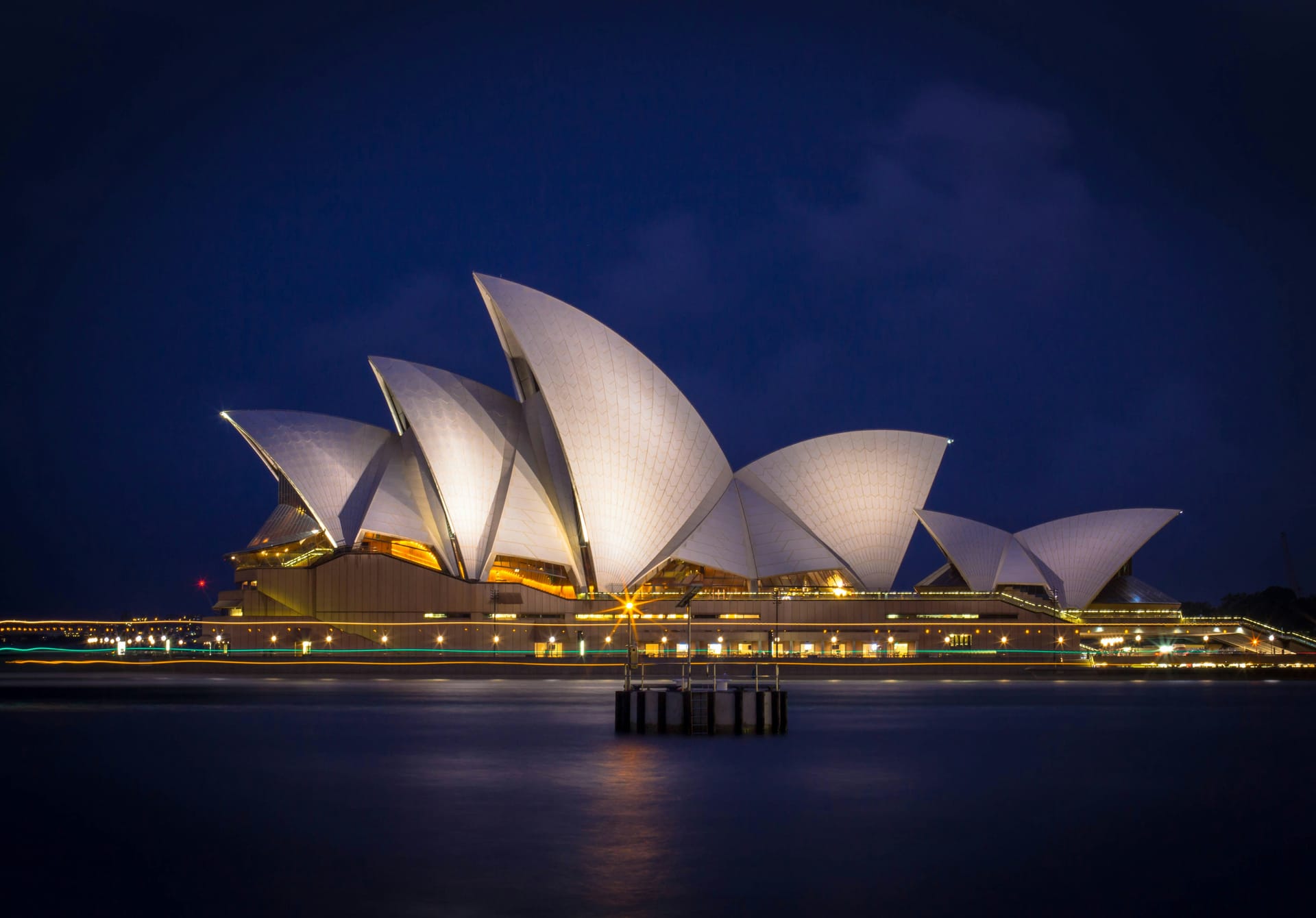
- Sydney Opera House — Utzon’s 1973 architectural masterpiece.
- Tasmanian Wilderness — 15,800 km² of cool temperate rainforest and glacial landscapes.
- Gondwana Rainforests — subtropical rainforests in Queensland/NSW, among the oldest ecosystems on earth.
- Fraser Island (K’gari) — the world’s largest sand island.
- Ningaloo Coast — Western Australian fringing reef, outstanding for whale sharks.
- Lord Howe Island — a subtropical Pacific island with unique biota.
National Parks
Australia has over 500 national parks covering roughly 4% of the country. Kakadu, Uluru-Kata Tjuta, Kosciuszko, Daintree, Great Otway, Grampians, Cradle Mountain, and the Blue Mountains are all significant destinations for either wildlife or landscape reasons.
Travel Guide: Practical Information
Entry
Australia requires an Electronic Travel Authority (ETA) or eVisitor visa for almost all international visitors. The ETA costs AUD $20 and can be obtained online in minutes for most eligible nationalities (US, Canada, Japan, South Korea, Singapore). EU citizens use the eVisitor (free). Both allow stays up to 3 months per visit. Working Holiday visas are available for under-35s from many partner countries.
Best Seasons
- September-November (spring) and March-May (autumn) — the ideal windows for southern Australia (Sydney, Melbourne, Tasmania). Warm but not stifling.
- June-August (winter) — dry season for the tropical north (Darwin, Cairns, Broome), which is the optimal time to visit Kakadu and the Kimberley. Cold in Tasmania and Victoria.
- December-February (summer) — peak beach season. Very hot across much of the country; bushfire season. The Great Barrier Reef has stinger warnings for box jellyfish in tropical north waters.
Transport
- Domestic flights — essential for long distances. Sydney-Perth is 4,000 km, a 4-5 hour flight. Major carriers: Qantas, Virgin Australia, Jetstar, REX.
- Train — Australia has iconic long-distance train journeys (the Indian Pacific Sydney-Perth, the Ghan Adelaide-Darwin) but these are tourism experiences rather than practical transport.
- Rental cars — essential for the Red Centre, the Great Ocean Road, the Kimberley, and Tasmania. Distances are enormous — Sydney-Cairns is 2,400 km.
- City transit — Sydney, Melbourne, Brisbane, and Perth all have reasonable urban train and bus networks, with Sydney’s Opal card and Melbourne’s Myki as contactless payment systems.
Budget
Australia is expensive. Sydney and Melbourne are in the world’s top 15 for cost of living. A mid-range daily budget is AUD $200-$350 ($130-$225) for accommodation, meals, and transport. Backpackers can reduce this significantly with hostels and self-catering. Tipping is optional in Australia — the minimum wage is high and service staff are well paid.
Etiquette
- Australians are informal — first names are the norm, “mate” is the default greeting for anyone, and heavy formality is considered standoffish.
- Sun protection is serious — the UV index reaches extreme levels across the country in summer. Hat, sunscreen SPF 30+, and sunglasses are not tourist suggestions, they are cultural rules.
- Indigenous sites — respect signs about photography and access restrictions. Climbing Uluru is banned; some areas of Kakadu require permits.
Surprising Facts
- Australia has more kangaroos than people — an estimated 50 million kangaroos against 26.6 million humans, with significant regional overabundance problems for farmers.7
- Canberra was built as a compromise capital — after Sydney and Melbourne refused to cede the honour to each other, a blank site between them was chosen and designed from scratch by American architect Walter Burley Griffin in 1913.6
- Australia has three federal time zones — but also uses half-hour time zones in the Northern Territory and parts of South Australia, and some areas briefly use 45-minute offsets during daylight saving.3
- Voting is compulsory in Australian federal elections — failure to vote without valid reason results in a AUD $20 fine. Turnout regularly exceeds 90%.6
- The boxing kangaroo became an Australian sporting symbol during the 1983 America’s Cup, when Alan Bond’s yacht Australia II beat the US to win the trophy for the first time in 132 years.3
- Australia lost a war against emus in 1932 — military units were deployed to cull emus destroying Western Australian wheat crops; the operation was called off after the birds proved nearly impossible to shoot effectively.6
Sources and References
See the list of cited sources in the page frontmatter — UNESCO, World Bank, Tourism Australia, the Australian Bureau of Statistics, the Reserve Bank of Australia, Encyclopaedia Britannica, and Parks Australia.