The Country That Went from Postwar Poverty to Cultural Superpower in 60 Years
South Korea’s modern history is one of the most dramatic economic and cultural transformations in human history. In 1960, South Korea was poorer than Ghana, Liberia, or the Philippines — its GDP per capita was around $158, and most of its population was rural and agricultural. By 2024, South Korea was the world’s 13th-largest economy by nominal GDP, with a per-capita income exceeding $35,000, world-leading semiconductor and shipbuilding industries, and a cultural reach (K-pop, K-drama, K-cinema, K-beauty, Korean food) that has made the country one of the most globally influential cultural exporters relative to size.
This “Miracle on the Han River” was driven by deliberate state-led industrialisation under successive military governments, an exceptionally educated workforce, and a national ethic that subordinated individual consumption to collective economic development. The transition to democracy in 1987 opened the political system to public choice; the 1997 Asian Financial Crisis triggered painful but ultimately successful economic restructuring.
The country has also navigated one of the world’s most fraught geopolitical situations — the Korean Demilitarised Zone (DMZ) along the 38th parallel separates South Korea from the Democratic People’s Republic of Korea (North Korea), with which it has been technically still at war (no peace treaty was signed after the 1953 Korean War armistice). Nearly 30,000 US military personnel remain stationed in South Korea.
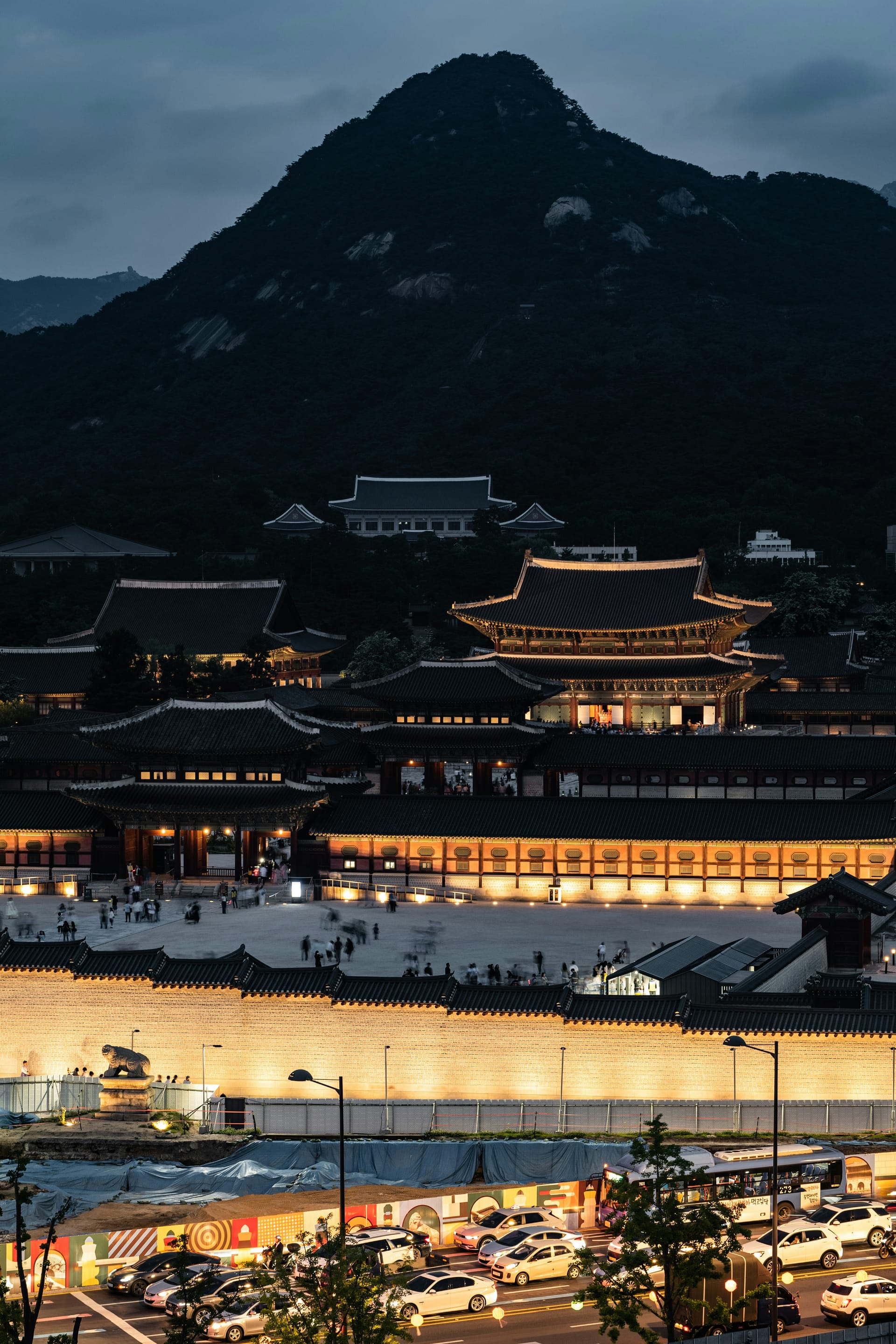
A Brief History
Pre-Modern Korea
The Korean peninsula has a documented history of nearly 5,000 years. The Three Kingdoms period (Goguryeo, Baekje, Silla, 57 BC-668 AD) was followed by Silla unification, the Goryeo Dynasty (918-1392) — from which the English name “Korea” derives — and the Joseon Dynasty (1392-1897), the longest-ruling Korean dynasty.
Japanese Colonisation
Korea was annexed by Japan in 1910 and remained under brutal colonial rule until 1945, including extensive economic exploitation and cultural suppression (Koreans were forced to adopt Japanese names, the Korean language was banned in schools).
The Korean War
The peninsula was divided in 1945 along the 38th parallel by the Soviets and Americans. The Korean War (1950-1953) — initiated by North Korean invasion of the South — killed an estimated 2-3 million people. The 1953 armistice has held without a peace treaty for 70+ years.
Industrial Transformation
Successive military governments under Park Chung-hee (1961-1979) and his successors drove rapid industrial development through state-directed credit, export promotion, and family-controlled conglomerates (the chaebols — Samsung, Hyundai, LG, SK).
Democracy and the Modern Era
The June Democracy Movement of 1987 forced the transition to democratic government. Kim Dae-jung’s 1998 election was the first peaceful transfer to opposition in Korean history. The country has since cycled between conservative and progressive governments. 2022 election brought Yoon Suk-yeol to power; his December 2024 declaration of martial law was rapidly reversed by the National Assembly, leading to his impeachment and removal in 2025.
Geography and Climate
South Korea covers 100,210 km² — about the size of Iceland — with mountainous terrain (about 70% mountain) and a long coastline. Mount Hallasan (1,950 m, on Jeju Island) is the highest peak.
Culture, Language and Religion
Korean is a language isolate (sometimes grouped with Japanese in unverified language families). The script — Hangul — was created by King Sejong in 1446 and is widely considered one of the most logically designed writing systems in the world.
Religion: approximately 30% Christian (split between Protestant and Catholic), 20% Buddhist, 45% unaffiliated. South Korea has one of Asia’s largest Christian populations as a share of total.
The Economy
South Korea has the world’s 13th-largest economy (~$1.7 trillion GDP in 2024). Key sectors: semiconductors (Samsung Electronics is the world’s largest memory chip maker; SK Hynix is #2), automotive (Hyundai-Kia is among the world’s top five carmakers), shipbuilding (the world’s largest shipbuilding industry — HD Hyundai, Samsung Heavy Industries, Hanwha Ocean), steel (POSCO), electronics (Samsung, LG), petrochemicals.
Cuisine
Korean cuisine is built around kimchi (fermented vegetables, with countless varieties), rice, soup, banchan (small side dishes accompanying every meal), and fermented sauces (gochujang chilli paste, doenjang soybean paste).
- Bibimbap — mixed rice with vegetables, meat, fried egg, gochujang
- Bulgogi — marinated grilled beef
- Korean BBQ — table-top grilling of marinated meat
- Korean fried chicken — twice-fried, glazed in spicy or soy-garlic sauce
- Kimchi jjigae — kimchi stew
Nature and UNESCO Sites
South Korea has 15 UNESCO World Heritage Sites, including Changdeokgung Palace, Bulguksa Temple and Seokguram Grotto, Jongmyo Shrine, Hwaseong Fortress, Jeju Volcanic Island and Lava Tubes, and Korean historic villages of Hahoe and Yangdong.
Travel Guide
Entry
Most Western nationalities enter visa-free for 90 days; an electronic travel authorisation (K-ETA) was required from 2021 but is being phased back for many countries.
Best Seasons
April-May (cherry blossoms) and September-October (autumn colours) are optimal.
Transport
KTX high-speed trains connect major cities (Seoul-Busan in 2h30). Seoul has one of the world’s most extensive metro systems (over 300 stations).
Budget
Mid-range $80-$160 per day; Seoul slightly more expensive.
Surprising Facts
- Hangul — the Korean script — is widely considered the most logically designed writing system in human history; it can be learned by an English speaker in roughly 90 minutes.6
- Samsung alone accounts for around 20% of South Korea’s exports and is large enough that the company’s performance significantly affects national GDP.4
- K-pop group BTS contributed an estimated $5 billion to the South Korean economy in 2018 — roughly 0.3% of GDP.3
- South Korea has the world’s lowest fertility rate — around 0.7 children per woman in 2024, far below replacement level. The population is projected to halve by 2100 at current rates.4
- Squid Game (2021) became Netflix’s most-watched series ever, with 1.65 billion hours streamed in its first 28 days, helping accelerate the global Korean cultural wave.3
- South Korean men’s age is calculated differently — until 2023, Koreans considered themselves one year old at birth and added a year on January 1, meaning a baby born December 31 was “two” by the next morning. The country adopted the international counting method in 2023.3
Sources and References
See the list of cited sources in the page frontmatter.