The Country Where Western Civilisation Was Invented
Greece occupies a place in Western self-understanding that no other country can match. Democracy, philosophy, drama, Olympic sport, mathematical proof, and the systematic study of history were all invented or given their recognisable modern form in Greek-speaking cities between roughly 800 BC and 300 BC. The English words for these concepts are themselves Greek — demokratia, philosophia, drama, mathema, istoria. Walk through any European capital and you will see buildings modelled on the Parthenon, phrases carved on courthouses (“with liberty and justice for all” translates ideas first formalised in Greek), and public squares named after Socrates or Pericles.
What is easy to forget — and what modern Greeks live with every day — is that the continuous link between that classical golden age and today’s country is more complicated than the mythic story suggests. Greek-speaking civilisation persisted under Roman, Byzantine, and then Ottoman rule for nearly 400 years (1453-1821), during which the classical heritage was kept alive mostly through the Orthodox Church, monastic scholarship, and the diaspora communities in Venice, Vienna, and Istanbul. The modern Greek state — independent since 1821 — is both the inheritor of an immense cultural debt and a young Balkan country still working out how to live with it.
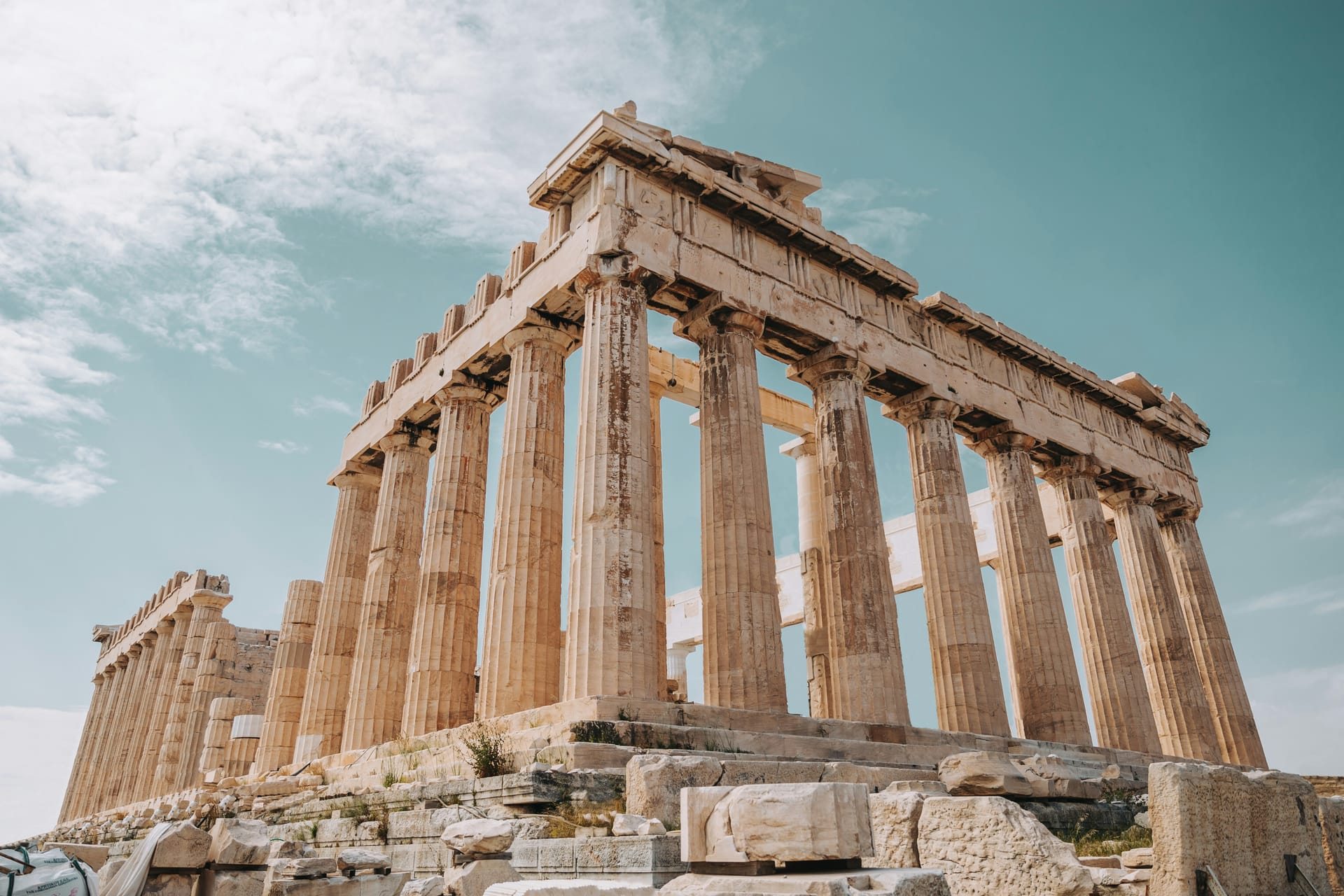
A Brief History
Pre-classical and Classical Greece
Greek-speaking peoples arrived in the southern Balkans around 2000 BC and gave rise to the Minoan civilisation on Crete (c. 2700-1450 BC) — arguably the first European civilisation — and the Mycenaean civilisation (c. 1600-1100 BC), whose heroic age would be mythologised in Homer’s epics. A dark age followed the Mycenaean collapse, after which Greek civilisation regrouped into roughly 1,000 city-states (poleis) — small independent political units scattered across the Aegean and Mediterranean.
The Classical period (c. 508-323 BC) produced the achievements most non-Greeks still learn in school — Athenian democracy, the Persian Wars (Marathon 490 BC, Thermopylae and Salamis 480 BC), the Peloponnesian War between Athens and Sparta (431-404 BC), the philosophical schools of Socrates, Plato, and Aristotle, and the architectural triumphs of Pericles’s Athens.
Alexander and the Hellenistic Age
Alexander the Great (356-323 BC) conquered an empire stretching from Egypt to the Punjab in little more than a decade, before dying in Babylon at 32. His successors split the empire into Hellenistic kingdoms that diffused Greek language, culture, and urban design across the Near East for three centuries.
Roman and Byzantine Greece
Greece was absorbed into the Roman Empire by 146 BC. When the Empire split in 395 AD, the Greek-speaking eastern half — the Byzantine Empire — continued for another 1,058 years, with its capital at Constantinople (now Istanbul). Byzantine civilisation, too often overlooked in Western education, kept Greek classical learning alive, codified Eastern Orthodox Christianity, and for long stretches was the most sophisticated political entity in the Mediterranean world.
Ottoman Rule
The Fall of Constantinople in 1453 ended the Byzantine Empire and placed Greek-speaking territory under Ottoman rule for nearly four centuries. Greek identity during this period was preserved through the Orthodox Church, Greek-language education in ecclesiastical schools, and the commercial and intellectual networks of the diaspora (especially the Phanariots of Constantinople, the Venetian Greeks, and communities in Trieste, Vienna, and Odessa).
Independence and the 19th Century
The Greek War of Independence (1821-1832) freed most of mainland Greece from Ottoman rule, with critical diplomatic and military support from Britain, France, and Russia. The new kingdom was initially a miniature of ancient Greece — not including Crete, the Dodecanese, Macedonia, or Epirus, which were added through later wars (the Balkan Wars of 1912-1913 and the aftermath of WWI). The 1923 population exchange with Turkey — which moved roughly 1.3 million Greeks from Anatolia to Greece and 400,000 Muslims the other direction — was one of the largest forced migrations in modern history.
The Twentieth and Twenty-First Centuries
Greece endured German occupation and civil war (1941-1949) — the civil war between communist and royalist forces killed an estimated 100,000 people. A military junta (1967-1974) fell after the disastrous Turkish invasion of Cyprus. Greece joined the EU in 1981 and the euro in 2001. The 2009-2015 sovereign debt crisis saw Greek GDP contract by roughly 25%, unemployment peak above 27%, and three EU/IMF bailout programmes totalling €289 billion. Recovery since 2018 has been real but incomplete; emigration of young Greeks during the crisis left demographic scars still visible.
Geography and Climate
Greece covers 131,957 km² (about the size of England) and comprises mainland Greece and more than 6,000 islands, of which roughly 227 are inhabited. The country has the longest coastline in the Mediterranean (13,676 km) and some of Europe’s most dramatic geography — steep mountains running into deep sea, with minimal coastal plain.
Regional Geography
- Central and Southern Mainland Greece — Athens and Attica, the Peloponnese, the Corinth Canal. Mountainous hinterland with ancient sites (Delphi, Olympia, Mycenae, Sparta, Corinth).
- Northern Greece — Thessaloniki (second-largest city), Macedonia, Thrace, Mount Athos (the autonomous monastic peninsula). Continental climate, larger agricultural plains.
- The Aegean Islands — divided into several clusters: the Cyclades (Santorini, Mykonos, Naxos, Paros, Ios), the Dodecanese (Rhodes, Kos, Symi, Patmos), the North Aegean (Lesbos, Chios, Samos), the Saronic Gulf islands (Aegina, Hydra, Spetses, Poros).
- The Ionian Islands — the seven main islands off the western coast (Corfu, Kefalonia, Zakynthos, Lefkada, Ithaca, Paxos, Kythira). Greener than the Aegean islands due to higher rainfall.
- Crete — Greece’s largest island at 8,336 km², a region in its own right with its own dialect and distinct culinary tradition.
Climate
Greece has a Mediterranean climate — hot dry summers (28-35°C, with heatwaves pushing above 40°C in recent years), mild wet winters (especially October-February). The northern mainland has more continental variation; the Aegean islands are drier and sunnier year-round; Crete’s southern coast (Ierapetra is Europe’s southernmost city) has a near-desert climate.
Culture, Language and Society
The Greek Language
Greek is spoken by around 13 million people worldwide — almost all in Greece and Cyprus, with diaspora communities in Germany, the United States, Australia, and the UK. Modern Greek is the descendant of Koine Greek (the common Greek of the Hellenistic period) and Byzantine Greek; the distinct Ancient Greek of the classical period is learned through formal education and requires systematic study even for native modern speakers.
The Greek alphabet has been in continuous use since around 800 BC, though the case endings, vocabulary, and idioms have evolved significantly.
Religion
Greece is constitutionally Orthodox Christian — the Greek Orthodox Church is the established church and has played a central role in preserving Greek identity through Ottoman rule and the modern era. Roughly 90% of Greeks identify as Orthodox, and church involvement (baptisms, weddings, funerals) shapes family life more thoroughly than in most Western European countries.
Mount Athos — the autonomous monastic peninsula in northern Greece — contains 20 major monasteries and has been continuously practising Orthodox monasticism since the 9th century. It remains closed to women (a prohibition dating back more than 1,000 years), an exception within the EU that is periodically contested.
Family and Social Life
Greek social life revolves around the parea (group of close friends or family), gathered around food, coffee, and extended conversation. The café culture — frappés in summer, freddo espressos in the hotter months, Greek coffee year-round — is foundational. Greeks consume roughly 5 kg of coffee per capita annually, among the world’s highest rates, and the coffeehouse (kafeneio) remains a durable social institution.
The Greek Cuisine
Greek food is one of the world’s most studied healthy diets — the Mediterranean diet was added to UNESCO’s Intangible Cultural Heritage list in 2010, with Greece as one of the co-nominating countries.
The Economy
Greece is a high-income country (~$240 billion GDP in 2024, around $23,000 per capita), though still recovering from the long shadow of the 2009-2015 debt crisis. The economy is service-dominated, with tourism and shipping as the two pillars.
Key Sectors
- Tourism — 33 million international visitors in 2023, a 3:1 visitor-to-resident ratio among the highest in the EU. Tourism contributes around 25% of GDP directly and indirectly — the highest tourism dependency in the EU after Malta and Cyprus.
- Shipping — Greek shipowners control approximately 17-20% of the world’s merchant fleet by tonnage, the largest share of any single country. Piraeus is one of Europe’s busiest container ports; the Greek shipping diaspora (London, New York, Monaco) is commercially enormous.
- Agriculture — Greece is a major EU producer of olive oil (#3 globally after Spain and Italy), cotton, tobacco, wine, and specialty cheeses (Feta has protected EU origin status). Greek olive oil is exceptional but under-branded — much is sold in bulk to Italian producers who bottle and export it as Italian.
- Energy and mining — Greece has been investing rapidly in renewables (especially solar and wind), with renewable share of electricity generation rising to around 50% by 2024. Lignite mining in northern Greece is in managed decline.
Structural Challenges
Demographics — Greece has one of Europe’s lowest birth rates and an aging population; emigration during the crisis (2010-2018 saw roughly 400,000 Greeks leave, disproportionately under-35) has left a demographic gap. Debt — public debt remains around 155% of GDP, though debt service costs have moderated. Productivity — Greek labour productivity has lagged Northern Europe for decades.
Cuisine
Greek food is built on a handful of core ingredients — olive oil, feta, lemons, tomatoes, fish, lamb, herbs (oregano, thyme, dill, mint), yoghurt, and phyllo pastry — combined in preparations that are typically simple rather than technical. The cuisine reflects a long peasant tradition and a Mediterranean diet that modern nutritional science has validated.
Iconic Dishes
- Moussaka — layered aubergine, minced lamb, and béchamel sauce, baked
- Souvlaki — skewered grilled meat, often served wrapped in pita with tzatziki, tomato, onion, and fries
- Gyros — rotating spit-roasted meat sliced and served with pita, similar to Turkish döner but distinctly Greek in spicing
- Spanakopita — spinach and feta pie in phyllo pastry
- Horiatiki (Greek salad) — tomato, cucumber, red onion, feta, kalamata olives, olive oil, oregano. Purists insist on no lettuce.
- Dolmades — stuffed grape leaves (meat, rice, and herbs)
- Stifado — rabbit or beef stew with pearl onions, cinnamon, and red wine
- Yiouvetsi — lamb or chicken slow-baked with orzo pasta
- Baklava — layered phyllo pastry with honey and nuts (shared with Turkey and the broader Levant)
Regional Variations
Cretan cuisine is distinctive — greater use of wild greens (horta), a wider range of local cheeses (including mizithra, anthotyros, graviera), and raki (clear spirit distilled from grape skins). Macedonian cooking uses more peppers and paprika; Ionian Island cuisine reflects long Venetian influence in its pasta dishes (pastitsio) and tomato sauces.
Drink
- Greek coffee — strong, unfiltered, served in small cups with grounds at the bottom. Drunk without milk.
- Frappé — iced instant coffee shaken with ice; a 1957 Greek invention that is now the afternoon summer standard.
- Ouzo — anise-flavoured aperitif, traditionally served with meze.
- Retsina — resinated wine with a pine-sap flavour, an acquired taste that anchors the old wine tradition.
- Tsipouro — distilled spirit, similar to Italian grappa, common in northern Greece.
Nature and UNESCO Sites
Greece has 19 UNESCO World Heritage Sites, nearly all cultural. Standouts:
- Acropolis of Athens — the Parthenon, Erechtheion, Propylaea, Temple of Athena Nike
- Archaeological Site of Delphi — the oracle’s sanctuary on the slopes of Mount Parnassus
- Archaeological Site of Olympia — the original site of the ancient Olympic Games (776 BC-393 AD)
- Meteora — six monasteries perched on sandstone pinnacles in Thessaly
- Mount Athos — the monastic peninsula (access requires advance permit, closed to women)
- Medieval City of Rhodes — the Knights of St. John’s 14th-16th century fortified town
- Old Town of Corfu — Venetian-era fortifications
- Mystras — Byzantine capital of the Peloponnese in the 14th-15th centuries
- Archaeological Sites of Mycenae and Tiryns — the Bronze Age heroic-age citadels
- Monuments of the Monastery of Saint John and the Cave of the Apocalypse in Patmos — where John the Apostle received the vision of the Apocalypse
- Aegean coast sites — Delos (the sacred island), Epidaurus (the ancient theatre), Samos (Pythagoras’s birthplace)
Natural Sites
Greece has 11 national parks, including the Samaria Gorge in Crete (Europe’s longest gorge at 16 km), Mount Olympus National Park (the mythological home of the twelve Olympians), Vikos-Aoös (with Europe’s deepest gorge by depth-to-width ratio), and Prespa Lakes on the Albanian-Macedonian border.
Travel Guide: Practical Information
Entry
Greece is a Schengen Area member — visa-free for up to 90 days in any 180-day period for the US, UK, Canada, Australia, Japan, and many others. ETIAS applies from mid-2026.
Best Seasons
- May-June and September-October — the ideal windows for mainland and islands alike. Warm but not hot, tourist numbers below peak, prices lower.
- July-August — peak. Santorini, Mykonos, and Rhodes are extremely crowded; Athens becomes unbearable during heatwaves (40°C+).
- November-March — off-season for the islands (many hotels and restaurants close on smaller islands). Athens remains worth visiting year-round; the ski resorts in Mount Parnassus and Pelion run December-March.
Transport
- Athens Metro — three lines, fast, clean, affordable. Connects the airport to the city centre in 40 minutes.
- Ferries — the backbone of island travel. Piraeus is the main hub; book summer crossings 1-2 months ahead. Fast catamarans (SeaJets, Blue Star’s fast services) are 2-3x the price of conventional ferries but cut travel times in half.
- Domestic flights — Aegean Airlines and Sky Express connect Athens to most major islands. Flights are cheap and short (Athens-Santorini is 45 minutes).
- Rental cars — essential for mainland exploration (Peloponnese, Northern Greece, Meteora) and for larger islands (Crete, Rhodes, Corfu).
- Buses (KTEL) — intercity coach network, affordable, slightly chaotic but reliable.
Budget
Greece is affordable compared to northern Europe — daily budgets of €80-€140 for mid-range travel are comfortable outside peak season. Santorini and Mykonos are exceptions — peak-season prices rival Ibiza and Saint-Tropez.
Etiquette
- Tipping is modest — rounding up or adding 5-10% at restaurants is customary, not mandatory.
- Restaurant timing — lunch starts around 1-2 PM; dinner rarely before 9 PM, especially in summer.
- Beach etiquette — many Greek beaches are free (access laws prohibit private ownership of the foreshore), though loungers and umbrellas usually carry a charge.
Surprising Facts
- Greece has no official atheists’ or agnostics’ national status — the Constitution explicitly identifies the Eastern Orthodox Church as the “prevailing religion” in Article 3, though it also protects religious freedom.6
- Greeks invented the modern marathon — the 1896 Athens Olympics introduced the 40 km race commemorating Pheidippides’s legendary run from Marathon to Athens in 490 BC. Marathon legends are largely 19th-century inventions; the run to Athens does not appear in Herodotus.6
- The Greek national anthem — “Hymn to Liberty” (Ymnos is tin Eleftherian) — has 158 stanzas, by far the world’s longest national anthem. Only the first two are sung at official events.6
- Feta cheese has protected designation of origin status in the EU — only cheese produced from sheep and goat milk in designated Greek regions can legally be called “feta” in EU markets.3
- Athens is one of the oldest continuously inhabited cities in the world — archaeological evidence indicates continuous urban occupation for at least 3,400 years.6
- Greeks don’t say hello on the phone — the standard greeting is “Embros” (literally “forward” or “onward”), a naval command adopted into telephony by Greek merchant marines.3
Sources and References
See the list of cited sources in the page frontmatter — UNESCO, World Bank, Visit Greece, Hellenic Statistical Authority, Bank of Greece, Encyclopaedia Britannica, and the Greek Ministry of Culture and Sports.